For those who are going through a breakup in the midst of this pandemic, the AB InBev wine brand BABE and the dating app Bumble teamed up in August, 2020.
They offered to cover moving costs via an Instagram giveaway. This includes a $600 pre-paid gift card to be used to purchase moving services. Plus, a $100 credit that can be used at BABE is also given for liquid solace to get over the darkest time. In addition to the monetary prize, Bumble also promised to “hand tailor” the perfect profile for the newly single mover and help “remove all traces of your ex from your phone.”
To enter, a newly single needs to comment or tag themselves or a newly single friend on a post on BABE’s Instagram feed. Bumble and BABE pick five winners, and those get their expenses covered.
Tag anyone newly single that needs help MOVING ON. BABE &@bumblewill pick 5 people and turn the breakup into a glow up. (Source: BABE Instagram)
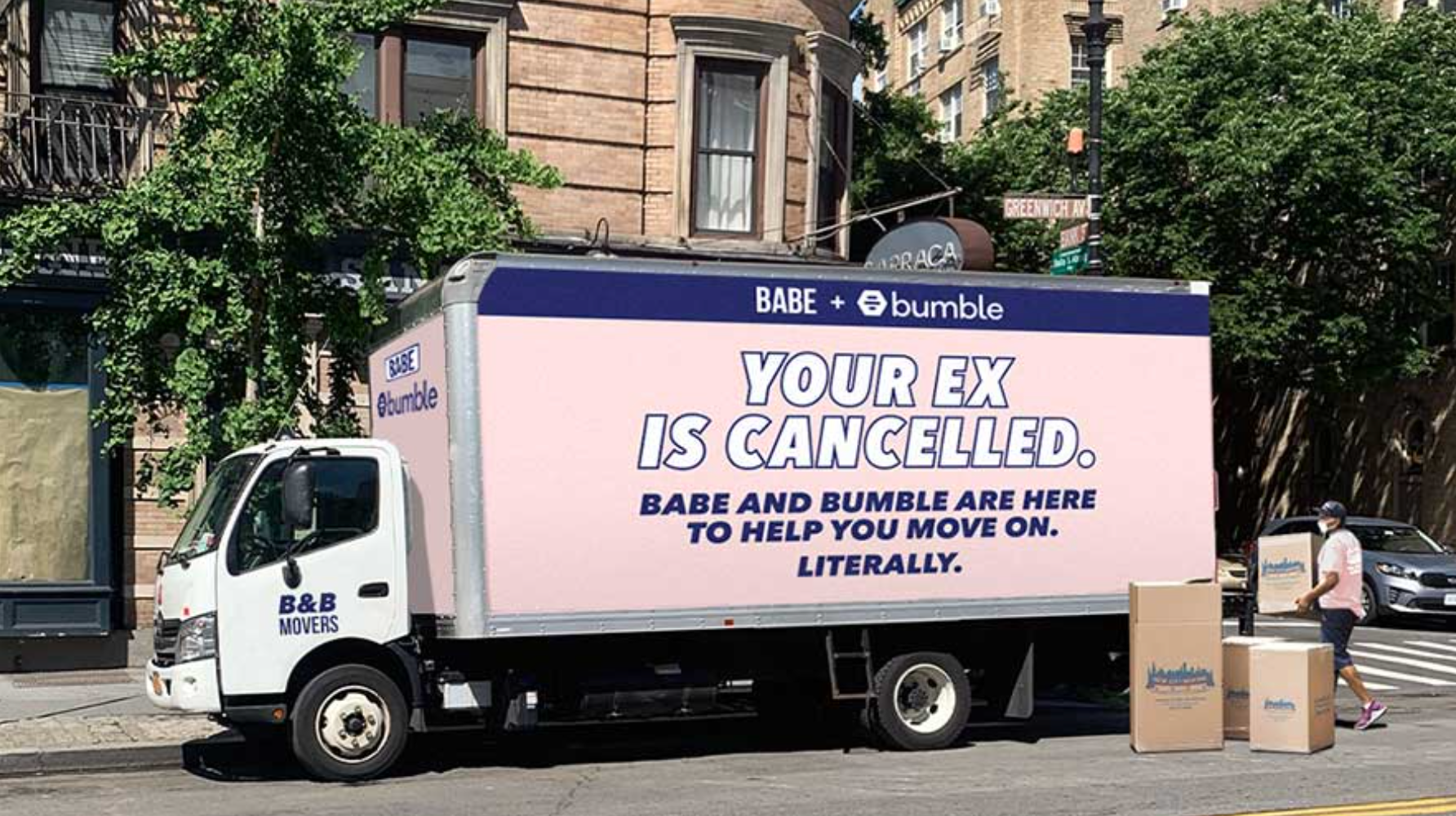
Babe and Bumble mocked up a moving company called B&B Movers using BABE’s brand color identity. Though they are not a real moving company, they made the truck that will come to the rescue.
They are equipped with a pink truck that reads: “Your ex is cancelled. BABE and Bumble are here to help you get a move on. Literally.”
Partnership across industries in the pandemic
Find the right partner
Bumble and BABE could make synergy right because they sell different things to similar audiences.
Bumble is popular among Gen Z(age 18-24) or millennials(age 25-34) rather than older generations(see the chart below). And the campaign with Bumble is another chance for BABE to reach young people. The market of canned wine is growing around the younger generation: the young consumers who seek convenience and value consistent are their main customers(Wine Spectator).
Source: CIVIC Science
Like any relationship, it’s important to make sure your partner doesn’t aim for your share while sharing the same target audience.
Why they targeted Instagram users
According to the Pew Research Center, there are substantial age-related differences in platform use. This is especially true of Instagram, which are used by 67% of 18- to 29-year-olds. Those ages 18 to 24 are substantially more likely than those ages 25 to 29 to say they use Snapchat (73% vs. 47%) and Instagram (75% vs. 57%). According to Mobile Marketer, American consumers aged 18-24 are most likely to engage with the social media campaign, followed by those aged 25-29. Therefore, Instagram was the most accessible platform for the two brands to meet their target audience.
As Instagram users tag themselves on promotional post, the brand could extend the campaign’s reach new customers who share their interests with friends and followers.
Zero waste, which has recently become a global trend, originated in the early 2000s. Then, from around 2010, named influencers and US media began to focus on the zero waste Movement, stressing the importance of environment-friendly lifestyle.
For the Zero Waste Movement, the zero waste shop is a symbolic space. Zero waste shop refers to a shop that minimizes the use of packaging materials and environmental pollution while selling products or services. The idea of buying a product that has less impact on the environment is already becoming the norm. Posts related to Zero Waste are also increasingly emerging on social media. The number of users are growling who share their local zero-waist shop, know-hows and tips, or useful products.
As more people are interested in environmental issues, zero waste shops are spreading too. The number of brands that specialize in zero-waste and produce products is increasing, as more and more people – especially MZ generation, the emerging generation with purchasing power and interests in social issues – are looking for a better zero-waste brand. Or local cafés or restaurants are also jumping on the bandwagon by removing disposable plastics from their stores.
Coffee capsules that you can use without throwing away, Source: Photo by Crema Joe from Unsplash
Buy as much as you just need, Zero Waste Shops
Brick-and-Mortar Zero Waste shops in South Korea
In general, single-use packaging has been widely used in retail industry. Everything we buy are all packaged in plastics and papers that are to be used once, and then be discarded. Additionally, products are being sold in bulk or the amounts per serving is packaged more than we need.
Against these practices that make wastes in product and consumption process, zero-waste shops suggest alternatives. They limit necessary packaging, adopt eco-friendly products without compromising the quality.
Still, the zero waste has just started and there is a far way to gg. With less than 10 stores in Seoul, many people may feel bothered to visit one despite the distance and inconvenience. Plastic-free or eco-friendly living is still a very difficult task, but with some stores or customers who are joining the zero waste journey, it may be possible. And here’s the list of some stores leading this drive towards better.
Almang Store opened in June, 2020. The Korean word ‘Almang(알맹)’ means ‘grain’ because the store only carries contents without unnecessary packaging. Also called as a refill station, they sell oil, spices, shampoo, conditioner, body wash products, detergents and other liquid necessities per gram.
A customer can pay for the amount they only need – one bring their own containers, scoop or pour the desired amount, weigh it on the scale, and pay for the amount they need. A customer pays less than when buying a whole new one. For customers who forgot to bring their own refillable containers, the store lends sterilized containers for those who do not carry any containers. However, they do not provide delivery service.
They also sell eco-friendly products such as bamboo toothbrushes, straws made of glass and stainless steel. And they do more than selling.
They store also collects garbage that is cannot be recycled. The plastic lid, for example. The plastic lids they collect are transformed to a toothpaste squeezer. They also play a role as a local community. For example, they hold workshops and classes for local residents or those who are interested. Recently, they joined ‘Brita Attack Campaign‘, a plastic-free campaign which claims to take back and reuse a water purifier filter(Brita), and hold a recycling workshop on Brita.
Located on a quaint side street in Seoul Forest, the Picker is the first zero-waste shop in Korea that opened in 2016. Started as an eco-friendly vegetarian café, the sell vegan menus – their meals and drinks do not contain cheese and eggs. Soy milk mayonnaise and almond milk are used instead. Vegan dishes include homemade Black Beans Burger, Chickpea Avocado Sandwich, and Banana Nut Open Toast.
They also sell grocery foods, grains, and vegetables. They also carry necessities you’ll need in daily routines: stainless steel, multi-use straws made of bamboo or glass, eco-bags, biodegradable floss, reusable wax wrap, natural loofahs made from dried real loofah fruit bowls made of grain, and the list goes on.
Bottle Factdory Of course, the café Bottle Factory does not provide single-use cups nor paper receipts. Instead, they lend a tumbler to customers who visit without a personal cup. This plastic-free cafeteria offers vegan dishes.
Also, they sell zero waste products including straws, bags, and other co-friendly supplies. Additionally, from 2018, they started package-free refill system. A customer can purchase biodegradable or e cleaning supplies such as laundry detergent and fabric softener.
They are expanding the move further. The CEO of Bottle Factory, Chung Da-woon, developed an app called “Zero Club”. People can download the app and accumulate points when they use zero-waste stores.
If you want to find more…
If you want to explore more stores in South Korea, you can visit here. The site shows a list of refill stations, plastic-free bakeries and cafés. If you are considering plastic-free living or waste reduction, visiting zero waste shops could be a good start. Not only they give you the new brand experience that might lead you deeper into the journey, but also you might find quality products unexpectedly.
Zero-Waste in Fashion
In the fashion industry, which is sensitive to trends and has to constantly come with new designs, has long struggled to get its arms around inventory. To solve this aged problem, the fashion industry is already adopting zero-waste in its deadstock inventory and unsold items.
Established in 2011 by designer Seon-ok Lim, Parts Parts is a designer brand that pursues sustainability. Representative Lim opened the PartsPARTs-lab in Buam-dong, Seoul in 2019. By using recycled materials and removing toxic chemicals generated in the production process, the brand is challenging to wastes.
Parts parts reduce wasted fabric by using only one fabric per product. It uses neoprene made of a material similar to that of a wetsuit. When attaching fabrics, the fabric bonded together using an adhesive method; the fabric is burnt and bonded without using chemicals.
North Face joined the ethical movement by introducing the ‘Eco Fleece Collection’ that recycles 1,082 million plastic bottles, through technological innovation and sincere efforts for sustainable fashion.
Finding that up to 85% of its environmental impact was coming from its own production process, they started to use recycled polyester in outdoor clothes(CountryLiving). Their eco-fleece fabric recycled 50 500ml PET bottles per jacket. Recycled materials from PET bottles were applied to over 100 styles across the entire product line, including clothing as well as shoes and supplies.
The brand also applied biodegradable materials to its products. The representative product is ‘City Eco Soul Down Jacket’. The outer and lining, threads and zippers, and the other complements are made of biodegradable materials, so that it can be completely returned to nature with 5 years of decomposition.
To reduce inventory wastes, the brand started to reform their products. Their gore-tex jackets are reproduced as coats, and men’s suits are transformed into women’s clothing. The important point here is that there is no carbon generation because the stock is reused.
Kolon Industries FnC’s outdoor brand ‘Kolo Sport’, which has been steadily continuing by expanding sustainable eco-friendly campaigns throughout the business, unveils the 7th ‘Noah Project’ in the wake of the 20FW season. The Noah Project, which has been in progress since 2016 to protect endangered animals and plants in Korea, selects one type of animal and plant each season and releases a collection.
Currently, the eco-friendly line Noah Project is applying 100% eco-friendly materials and eco-friendly techniques to all products. They use materials that are recycled from waste PET bottles, nylon, and organic cotton cultivated in eco-friendly methods.
A model wears Noah Collection products. [KOLON SPORT]
Meanwhile, Kolon Sport plans to apply eco-friendly materials or eco-friendly construction methods to half of Kolon Sports’ products by 2023, the 50th anniversary of the brand launch. Stores are also transforming into eco-friendly stores. The brand developed biodegradable hangers and mannequins to reduce the use of plastic in stores.
Patagonia participated in the development of the organic standard ‘Regenerative Organic Certification’ to revive the global environment. (Source: Patagonia)
In 2018, Patagonia organized the ‘Regenerative Organic Alliance’ (ROA), focusing on regenerative organic farming, which can commit to solving climate change problems. Since then, the brand has developed a high-level organic standard renewable organic certification.
They adopted a number of regenerative processes like cover cropping, intercropping(planting other crops between the ridges where one crop is planted) or compost, and absorbing carbon dioxide from the atmosphere into the ground.
Zero-waste in Vegan Beauty Industry
Many beauty brands are adopting organic, zero waste as their brand philosophy. They ban animal testing, avoid chemical substances and plastic packaging, and share know-hows and tips on sustainable action to protect earth.
With the slogan of acting for the environment, TOUN28 is striving to minimize the use of plastic by stably containing cosmetic ingredients in recyclable paper packages that have been tested more than 500 times. They act against animal testing too. Their vegan products do not use animal or animal-derived ingredients, including meat, fish, honey, eggs, and dairy products, and are crafted from plant-based ingredients.
They developed a biodegradable paper container for cosmetic to reduce plastic waste. They also succeeded to develop the world first recycle-labelling paper package. They are still on the journey to make a 100%-biodegradable paper container with no plastic cap.
Aromatica is a vegan and cruelty-free brand that creates efficacious formulas. The products are produced sustainably and are free of synthetic fragrances. Aromatica ensures that its products have the least possible impact on the environment. Their brand mission clearly states “Save The Skin, Save The Planet.”
For packaging, the brand uses recycled glass and post-consumer recycled(PCR) plastic. The brand continuously improves upon the packaging to make it more sustainable. To keep up with its eco-friendly approach, the brand even discarded the use of pump applicators made of polyethylene(PE), polypropylene(PP) plastic and metal springs. Instead, they have switched to using PP flip caps that are easier to recycle.
Why is Zero Waste Movement spreading?
Zero waste movement and branding
As mentioned above, zero waste or eco-friendly moves are nothing new. However, as MZ generations emerged as a new purchasing power, sustainability and ethical consumption has become a new standard. And the growing demands are changing the game, turning over the conventional production and consumption process in ways to minimize the negative impact on the environment.
Increasing numbers of companies are actively recycling resources to capture the MZ generation that pursues ‘value consumption’ such as purchasing eco-friendly products. They publicly support and advocate what they value. the majority of Generation Z(54 percent) state that they are willing to spend an incremental 10 percent or more on sustainable products(Forbes). New York University Center for Sustainable Business(CSB) reaffirms this shift. According to November 2019 Fortune story, CSB found 50 percent of sales growth among consumer packaged goods (CPG) between 2013 and 2018 came from sustainability-marketed products, despite the fact such goods account for just under 17 percent of the market.
Sustainability: A key strategy to brand survival and grwoth
Plastic free challenges that have swept the social media also indicates how many young people are interested in environment issues. Vegan craze and eco-fur consumption share the same context. Pursuing sustainability is no longer niche. With this changes, many brands hopped on the bandwagon of zero waste. Now, sustainability has become a vital element for survival for many brands.
In the digital age, it is often said that the print industry is going downhill. But still, professional magazines have been solid over years, being beloved by many. Plus, unlike the past, magazine is not exclusive for a few editors and journalists anymore. Various independent magazines have appeared, and brands are competitively publishing their own print and digital magazines.
But why do brands make magazines?
First, in the age of saturated digital media, high-quality paper magazines is an outlet that brands can differentiate themselves. The look and feel of printed text and images is way different from that of digital. Second, a series of curated content that a magazine contains helps attract customers.
Still, there are questions. Do the brand magazines really sell? Yes – because they provide informative and valuable knowledges that suit their customers. Plus, many magazines showcase artistic graphic design that are visually attractive. Then, let’s take a look at some prominent brand magazines.
The Furrow
by John Deere
John Deere <The Farrow>
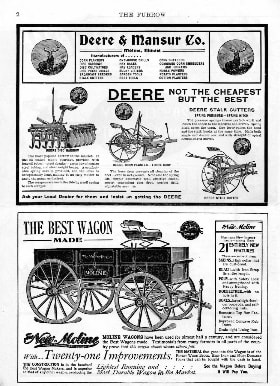
John Deere, a blacksmith in Vermont, USA, founded the agricultural magazine The Furrow in 1895. When there was no word for marketing, The Furrow was the only agricultural curation magazine with 4 million subscribers in 1912.
In fact, there is only one reason John Deere created The Furrow. It was ‘to sell a tractor’. However, since the first issue of The Furrow, John Deere’s tractor has not been publicly promoted. However, they continued covering audience-focused topics that might interest farmers, from the latest agricultural technologies to a guidance of how farmers grow as entrepreneurs. Their content goal was to make farmers more prosperous, not to advertise their products. Ironically, it was how they could make money – educate their customers about new technologies and give advice to solve problems they have.
As a result, even without advertising, John Deere’s tractors sell more and more year after year. For farmers who are already consumers, John Deere has established itself as a leading agricultural machinery brand. With over 2 million subscribers worldwide, The Furrow still prints almost every publication for its enthusiastic readers.
The Red Bulletin
by redbull
Source: Red Bull
Red Bull have linked the concept of energy drinks to sports and adventure. It sponsors various competitions, organizes events, produces various contents, and also directly operates media that covers high-quality content.
Their magazine started as a guidebook that shows the result of the F1 match. Red Bull was the main sponsor of the Formula 1 competition in 2005. At the time, Red Bull set a simple goal of providing a printed guide with the results to Formula One fans who exit immediately after the match.
Two years later, Red Bull decided to develop this F1 publication into a lifestyle magazine. The magazine was published in five countries under the name “Red Bulletin”, with 70% of global articles and 30% of each country’s local articles. The focus moved from people who love extreme sports to people who pursue extraordinary achievements and adventures. Called visual storytelling, the magazine provides powerful visual images and curates various topics related to their audience’s interests.
Now with expanded content portfolio, the Red Bulletin features sports, culture, music, nightlife, entrepreneurship and lifestyle stories every month. Now, 2 million monthly publications are issued in 11 countries, making the magazine one of the most popular brand magazines in the world.
F
by Baemin / Food Delivery Company
If you are a Korean, you’ve probably heard of <F>, a magazine published by Baemin. Baemin is a food delivery service company, which is known for B-class sense of humor and outstanding marketing attempts.
Magazine <F>
In March 2018, Baemin published its first issue of ‘Magazine F’, a food-based magazine. They made an experimental attempt create a cultural fandom, with the stories of food and people.
Magazine <F> covers one ingredient per issue. The stories include history of food ingredients, industry, city, culture and people – any topics related to the ingredient. The magazine serves a perfect guidance for readers with a bunch of valuable information processed from interviews, academic manuals, and researches. After reading this magazine, you will realize that Baemin is not just a brand that pursues B-class popularity.
Directory
by Jikbang / Digital Real Estate Agency
Source: Jikbang(직방)
Jikbang is a digital real estate platform. With Bold Magazine, the brand publishes a magazine that focuses micro aspects of individual living experience. Their magazine <Directory> records the humanized, personal stories of a couple of millennials living in studios, shared houses, or small apartments.
The interviewees – millennials, their targeted audience – featured in this magazine are ordinary like anyone of us. Their individual life isn’t that different from ours, but the magazine focuses on the meaning given to each space in which they live and their tastes blend. Rather than seeing the house as an investment for the future, the magazine perceives it as the space where people live and love.
Through the magazine that contains stories of personal living experience, Jikbang has taken a step further as a lifestyle brand beyond a platform that merely serves as a real estate agency.
Print magazine as a marketing medium
Other brands such as Airbnb, Metropolitan, Intelligentsia also have published paid magazines over years. Brand magazine is often used as a tool to communicate and engage with their targeted audiences. Curated with customized stories, magazine helps the brands to attract public attention naturally and provide more opportunities for audiences to explore more about the brand. Furthermore, it becomes a medium to form a fandom or community.
But there’s one premise – whether it’s digital or printed, the content should be written from a audience perspective.
According to a report published in 2015 by online marketing consulting firm Kissandra, 93% of parents said their children affect family spending and household purchases.
In a 2016 study by Marketing Vendor Interaction, 70% of parents reported that they listened to Gen Z’s advice when buying items online.
The decision makers influence all over the area. According to the IBM Institute for Values, for food and beverage, 77% of parents are affected by their Generation Z children. 76% for households, 66% for travel, 61% for electronics, and 60% for clothes and shoes.
Source: Uniquely Generation Z, IBM
As above, if Gen Zers are powerful opinion leaders or will be, what are the characteristics you must remember when marketing?
3 major characteristics of Gen Z
Value-oriented
The quality of a product or service and brand value are still important to Gen Z, but they more actively link the value to social responsibility. According to a survey by US consulting firm Futurecast, 60% of teens said they would consume brands that are faithful to their social role.
Then, what is the social role of the brand that Gen Z considers particularly important? According to the IBM Institute for Value, the keywords of Gen Z’s favorite brands are eco-friendliness, high quality, and social responsibility.
According to former Wall Street analyst and Forbes top 8 investor, Mary Ricker, Gen Z prefers a brand that advocates environmental protection, child relief, fair trade in the production and sales process of products, and creates pleasant content in the process of using products.
If a particular brand has had a negative influence on society, they also actively boycott. Gen Zers, the most socially conscious generation, put their money where their values are; look at Patagonia, Reformation or other fair trade brands.
Gen Zers prefer mobile
2) They’re protective of their privacy
Gen Zers love to share personal experiences on social media, but they’re also keen to protect their privacy.
Cyber-savvy Gen Zers have witnessed many cyber hacking crises and have learned the importance of privacy and security at schools. They’re more inclined to cover the webcam on their laptops and install ad block than previous generations.
But, according to IBM’s survey Uniquely Gen Z, 61% would feel better sharing personal information with brands if they could trust it was being securely stored and protected.
Companies should be transparent regarding data collection and use. Policies on privacy and security should be accessible, and a company should show how much they care for their privacy..
3) Digital natives shop in offline stores as well
Source: @cardmapr, Unsplash
Despite Gen Zers often use web browser for shopping, they still love browsing in store. According to CSA, sixty percent of Gen Z shoppers still prefer to purchase in-store, and 46% will still check in store to get more information before making an online purchase. In the U.S., 77% of Gen Z respondents said that brick-and-mortar stores is their preferred shopping channel.
They love “real” experiences, even waiting in a long line to buy limited-edition products. This is why many brands focus on building omni-channel shopping experience for customers- linking Online to Offline, which connects social media browsing to actual purchases.
Source: Uniquely Generation Z, IBM
In search of authentic brands
From 3 characteristics of Gen Z above, the things they love can be expressed in one word: authenticity.
The authentic brand that value social causes
The authentic brand that really cares customer privacy
The authentic experience that they can directly see and feel
In the book “Marketing to Gen Z” written by two authors, Jeff Fromm and Angie Read, describes Gen Z as a prudent consumer, a generation that acts with the belief of ‘changing the world’.
As a prudent consumer, they rather believe their friends or other buyers than influencers or celebrities. Keep themselves consciously away from marketing hype, they choose authentic brand or at least the brands they feel so.
Gen Z, the most smart & tech savvy generation, can easily detect whether the brand is authentic or not. They distinguish paid and organic reviews with a few hints. And the words and reviews of those opinion leaders spread quickly on social media and affect others’ decision making.
In the world where authenticity rules, the brand needs to be perceived as reliable, respectful, and real. Building authenticity include transparent communication, dedication to social causes, active social listening and feedback, keeping promises. To raise credibility, consistency can only help. No shortcuts.
Red Bull, widely known as the originator of energy drinks, introduced energy drinks to the market for the first time. Now they have expanded their fame beyond product marketing.
With its tagline ‘Red Bull Gives You Wings’, the company focuses on the idea that their product gives people the “wings” when people need energy to do what they love.
Source: News24
Becoming a pioneer
Red Bull has differentiated their product from existing beverage companies by pursuing to be a pioneer, categorizing the product as energy drink, unlike other caffeinated soft drinks.
To promote their new product, Red Bull distributed samples in places where caffeine consumption was prevalent, such as office buildings, bars, night clubs and gyms, not supermarkets and retail stores.
Targeting young and urban youth
To introducing a new product – energy drinks, the company should newly find their target customers. They are not the middle-aged people, who are the main customers for the existing competitors. Or they even sacrifice a few hours of sleep to enjoy sports or rock festival. In one word, simply, they live young and active.
Men between 16 and 36 years old
Urban lifestyle
Love extreme sports, gaming, music or active lifestyle
Adventurous, active
As their target is newly defined, accordingly, the company tailored their content to their target audience.
They focus on topics like extreme sports, music, art, dance and whatever people become enthusiastic. Because of that broad spectrum, their content cover various topics and can appeal to the right audience.
Engaging with sports lovers
Source : Red Bull
Sponsoring major extreme sports
Setting themselves as a highly ego-expressive product, Red Bull embraced extreme sports as their marketing strategy. This helped them to engrave their presence to the public. Red Bull acquired the existing Jaguar F1 Team in 2005 and re-founded it as the Red Bull F1 Team. As an emerging powerhouse, the team climbed to the second place in 2009, showing off their presence.
The biggest reason Red Bull invested in the F1 racing team was to increase its brand awareness and promote sales through F1. The marketing effect of F1 is known to be particularly effective in Europe, where F1 is popular.
Now Red Bull owns and operates four international soccer teams, two Formula 1 racing teams and 1 hockey team.
Sponsoring minor sports
Plus, Red Bull also sponsors not well-known or unique sports such as street basketball, mini-drome, motorbike, surfing, mountain bike, skydiving, etc. Red Bull also hosts extreme sports competitions such as Redbull Rampage, MTB, Red Bull Air Force etc.
For example, the mini-drome is an ultra-mini cycle game played in a place where the existing cycling stadium, velodrome, is down-scaled to a tenth. In other words, the average circumference of the cycling stadium is 250m, but the mini-drome is 14m long and 7m wide, so you can enjoy thrilling and exciting games.
Source: Red Bull
These events and sports stories are fully covered on their website, which attracts their target customers visit pages and engage with the branded content. Surprisingly, each quality content has no mention of their product.
Challenging to limitations
Source: Red Bull
Red Bull continued making bold moves even in inaccessible area: Red Bull aired the supersonic free-fall experiment called Red Bull Stratos. In this project, the skydiver goes up to 120,000ft (36km or 24 miles) from the Earth surface, then freely falls and breaks at the speed of sound. Through the camera attached to the skydiver’s body, Red Bull aired all information including the current height, falling speed, and skydiver’s heart rate.
This historic project, which challenged human limitations, attracted attention and the streamed YouTube video captured 8MM+ concurrent viewers.
Expanding their realm – Culture marketing
The Red Bull expanded their sports marketing to culture marketing, involving various playgrounds of music, dance, art, and social innovation. They have soared into pop culture and extended their reach to meet more customers.
For years, Red Bull has executed culture-focused marketing initiatives through engaging events at local, regional, and international level.
Dance competition
Red Bull BC One has become one of the biggest breaking competitions in the world. Every year, thousands of breakers compete in the tournament for a chance to represent at the Red Bull BC One World Final.
Red Bull also holds “Dance Your Style” competition every year. Recently, it collaborated with a video-sharing app TikTok and transformed it into a virtual event.
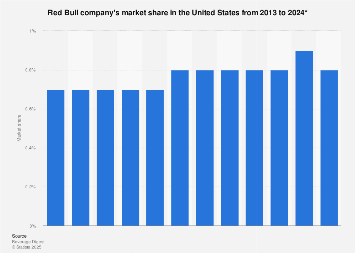
With the success of such brand marketing, Red Bull’s sales have grown steadily. There was also a crisis of some sales declines, but its gradually expanding its market share.
Source: Statista
Key Takeaways
Creating content around what their audience Loves
Energy drinks are also not recognized as high-performing product before. As a result, there is a growing possibility that consumers will not accept the brand value that Red Bull pursues.
However, Red Bull has used its edgy business model to establish itself as a sports marketing powerhouse. Transforming into a culture marketing-focused brand, Red Bull now produces magazines, TV programs, online videos, music, photos that feature relevant topics.
Every piece of content that they create matches the quality of other publications their target audience might read like Buzzfeed, Vice, ESPN, and more. For example, They produce a magazine, The Red Bulletin, which circulates over 2.2 million copies a month. The online videos are reviewed as awe-inspiring, and same for photos.
Red Bull’s consumable content thoroughly revolves around their audience’s interest. Having transitioned from an Austrian energy drink company to a global lifestyle brand, Red Bull was able to make an impressive brand image that their target customers love.
“Give to get” – this simple trading strategy is also applicable to the marketing world. Companies want customers attention and their loyal affection. Customers want the valued information they are looking for.
Here are the best practices of companies that mobilized this simple strategy. They gave customers relevant content of their interests, and got their affection in return.
1. Red Bull
Red Bull branded their content with a strong focus on their customers. Their website is full of content related to extreme sports, gaming, music, leisure sports, and anything else that might capture the attention of their target audience.
Red Bull mobilizes all media they can fetch(videos, social media, blogs, images, magazines, TV, etc.) to provide the interests of customers. It’s a bold and genius way to capture the attention of their target audience, instead of direct promotion of their products.
RedBullContentPool.com is another way that Red Bull cares their customers’ interests and lifestyle. They provide high quality stock photos and videos for editorial use, by publishers, news agencies, TV stations, etc., often with a Red Bull logo embedded.
2. John Deere
Not many people are familiar with John Deere. However, if you know a little about content marketing, you might be familiar with it. This is because it is the progenitor of content marketing.
John Deere is a brand of Deere & Company, an American company that manufactures axles, transmissions, gearboxes and lawn care equipment for use in agricultural, construction and forestry machinery, diesel engines and heavy machinery. This industry doesn’t seem match well with the magazine. However, John Deere publishes the agricultural magazine The Furrow, which was first published in 1895.
Farrow rarely mentions John Deere. It provides information that consumers need and wants to know. This simple fact of providing the information customers need is difficult to maintain in practice.
3. Coca-Cola
Coca-Cola mobilized a simple but powerful psychological motivation that everyone has: “I want to be called and recognized as myself”. They selected 150 of the most common names in Australia, so that you can drink your own’Custom Coke’ by engraving it on a bottle of Coke. The reaction of the public was explosive. People fought and bought a coke bottle with their name on it.
After the great success in Australia, Coca-Cola expanded its campaign to the world. The success factor of this event lies in’customization’, which seems to be for each customer. When the public purchased a bottle of cola with their name, they felt as if they had become a special person, which soon led to explosive consumption.
4. Buffer
Social media company Buffer is known for its radical approach to transparent communication. They even shared salaries of all 71 employees, posting them on a public website. Buffer employees reveal themselves and post writings on private stories such as their personal experiences, corporate culture or problem-solving methods that Buffer uses for clients.
Buffer’s open blog contains simple but powerful keywords of trust, openness, and communication. Those who know the blog can get detailed information on how the buffer works. It feels as if you are part of a secret club that shares high-quality information.
This psychological effect is called the velvet rope effect. When you go to the club, you’ve probably seen velvet ropes wrapped around the space for VIPs to limit access. A space only for the chosen people, which seems to be invisible. People are enthusiastic about the fantasy the velvet rope gives, and they dream of being included in the space beyond.
Buffer’s open blog is the VIP zone beyond the velvet rope. The best VIP zone that explains customer’s curiosity in detail inside the company.
Takeaways
Always focus on creating value for your customers. Share valuable information that cannot be easily found or only you can provide.
Food advertisements typically stimulate people’s appetite with mouth-watering visuals. Or fancy video clips that zoom the lettuce falls under water splash take over the full screen.
This year, however, Burger King made a bold decision against the mundane practice. There were no videos that highlight lettuce falling with water splash or beef patty grilled. Instead, Burger King showed off their ugly burger, decaying through 34 days.
The “Moldy Whopper” campaign only shows how the burger gets moldy over a month. The Whopper, topped with onions, lettuce, tomato, mayonnaise and pickles, appear at the center of the advertisements. The Whopper, containing no artificial preservatives, paradoxically demonstrates how fresh and healthy their food is.
To promote their promise of no preservatives, Burger King proclaimed their menu — including sandwiches, sides and desserts — will be free from artificial colors, artificial flavors and artificial preservatives in the U.S. and select European countries by the end of this year.
The Drum
McDonalds, brand-less branding
January, this year, McDonald went bold with its billboard advertisement. Instead of images of fancy burger, their beloved menu — including the Filet-O-Fish, Big Mac, and Sausage McMuffin — were introduced with a short list of its ingredients on the big screen. The color was also matched to each ingredient. McDonald’s campaign let the ingredients do the talking.
Plus, they removed their logo. This minimalist design is drafted by David Schwen from the advertising agency Leo Burnett London contain only the contents of the McDonalds menus.
By taking this brand-less approach, they made their ads incredibly simple but distinguishing. Unlike tons of branded content that talks too loud, McDonalds went less.
These ad campaigns of two burger kingdom conveys the minimalist trends. The idea of less can be found anywhere — from our lifestyles to branding. “Stay simple, stay healthy.” More and more beauty, vegan, or the other health-related brands are now adapting the idea of less. Get rid of redundant supplements. Sometimes, less works more.
The top ranking of search engine results page(SERP) already became a competitive market for brands. SEO marketing has already become an attractive marketing strategy especially for small businesses in that their website can land high when the it is well built with quality content.
There are already hundreds of guides and tips for SEO marketing – from simple ones to complicated ones. However, this page is to summarize the fundamental tips for beginners in an easy-to-understand way.
[Definition] What is SEO?
SEO, an acronym of search engine optimization, is the process of optimizing your website to get organic traffic from the search engine result page. In other words, SEO strategy aims to build your website more attractive to a search engine.
What content do search engines prefer?
Search engines are to give users what they are looking for. Put it simply, search engines work for users. They use their own algorithms to provide the best result for users.
Based on their own algorithms, search engines discover content pieces (crawling) and categorize them based on relevancy (indexing), and put them in order based on its own ratings (ranking).
Benefits of SEO
Well built SEO helps a brand meet more audiences. By creating more engaging and effective SEO-focused content, a brand website can have more organic traffic.
Content relevance and Website authority are both important
This means delivering results on the search engine pages that are not only high quality but also relevant to what the searcher is looking for. If your content isn’t relevant to search keywords, then it has little chance of ranking, no matter how credible it is. If your website isn’t credible, then it has little chance of ranking, no matter how relevant the content is.
SEO is the process of building relevance and authority
How to build relevance? Create high-quality & relevant content (On-Page SEO) How to build authority? Build high-quality links (Off-Page SEO)
On-Page SEO
Though creating content takes time and resources, it will more than pay off in the end.
The on-page SEO factors are the ones you can control on your website.
Fundamental checkpoints: Crawl Accessibility Before make the content, make sure that your website or content are searchable. They should be public for search engines to discover them.
What topics to choose? Build Topical Relevance Figure out which topics you want to be known for. Think about what users want to know. Choose the topic that satisfies both will help attract more traffic. Mind that a post should be able to answer searcher’s question and query.
Also, remember that engines such as Google rewards freshness. Google introduced a freshness factor into its ranking algorithm in 2011.
Use Relevant Images Choose the right images for your content. And optimize images by resizing images for proper page load time. Include captions also help boost visibility.
Secret to be the first? Simple. Just go one step further than the first runner. The formula to rank #1 on SERPs is that simple. Identify pages that rank high for the keywords you want to rank for. Create better content than they got.
On-site SEO covers more than creating relevant content. The elements that you can control for better website, such as content format or website design, are also included.
Keyword optimization to attract traffic Integrate keywords into the content but be cautious of over-using them. But do not overuse them. Google penalized keyword stuffing. The content should create more values to users beyond just incorporating keywords into the content.
Title Tag A title tag is an HTML attribute that specifies the title of a web page. Title tags are displayed on SERPs in a clickable format. The title tag of a web page is the first thing users notice and it should be a concise description of a page’s content.
Alt Text (alt attribute, alt description) An alt text is an HTML attribute applied to image tags to provide a text alternative for search engines. Search engines such as Google can’t see the images. Instead, they collect text. Search engine crawlers read the alt text value and associate images with a web page’s content. Therefore, applying alt texts to relevant images can positively impact search engine rankings. (Using relevant images is another fundamental tip for SEO marketing) The alt text that describes the image should be accurate and concise. For example, it’s better with “beagle dog playing fetch” than “beagle dog” (ReliableSoft).
Meta Description The meta description is a brief summary of a web page — typically up to 160 characters long. Sometimes it is okay not to write any meta descriptions, but normally it is recommended to a accurate and attractive copy for a web page. However, you should avoid duplicate meta description tags (MOZ, more tips for meta description)
Responsive Design Considering that approximately half of all web traffic are made from mobile, it’s safe to build a website with responsive design. Responsive websites are designed to fit the screen of whatever type of device your visitors are using. As users don’t have to tap twice to optimize the screen size, a responsive page helps visitors navigate the site more conveniently. Great user experience includes a fast load speed and compelling UI/UX design. Make sure whether your web page is SEO friendly, especially for mobile users.
Page Load Speed Make your website faster. People abandon and leave a web page when it takes too much for loading. If it takes more than 3 seconds to load your page, then the 40% of customers leave web pages. Don’t make slow page speed kills traffic.
Links Don’t let any broken links on a web page harm its authority. You can use tools like Dead Link Checker to search for links with errors on your website.
Clean and formatting page URLs URLs help describe a web page to search engines and users. Short, accurate, enticing, and well-structured URLs are considered appropriate. For more tips for URLs that work, you can refer to: Tips to create SEO-friendly URLs.
Advanced Optimization for Featured Snippets A featured snippet is a summary of an answer to a user’s query, which is displayed on top of Google search results. It’s extracted from a web page and includes the page’s title and URL.
If your post ranks in top(#1 ~ #5) positions, you could use featured snippet optimization to stand out in SERPs.
Featured Snippet (source: Act-on.com)
MakeStrategic Updates: Historical Optimization Google and other search engines love fresh content. However, rather than start from square and build all things up, it is much easier to achieve the goal by updating the existing posts – thereby generating more organic traffic than they already do. This refurbishing process is called historical optimization.
Off-Page SEO
Off-Page SEO is mostly about building links. Once you’ve got everything in place, it’s time to expand your influence by earning attention and links from other sites and influencers.
Search engine works for searchers. Their mission is to provide a site that visitors can trust most. One of the best ways that your website can earn trust is by building quality backlinks from sites that have trust (or authority).
Backlinks (or Inbound links) Backlinks are a signal to Google that your site is a high-quality resource that people want to reference. That means that sites with MORE backlinks – and higher QUALITY backlinks – tend to earn higher ranking in search (Hubspot).
Give to Get : link building Too boost SEO, build relationships with influencers or website with quality content can help. If you can encourage more people to link your website from theirs, you get higher chances of getting upper ranking. When you put a backlink of certain content, you can inform the original creator (tag him/her or mention it) and request to do the same for you. Link building for SEO is also building human networks. And do a favor is always a valid tactic to get what you want.
Photo by Web Hosting on Unsplash
SEO vs SEM
Search engine marketing is a form of Internet marketing that involved the promotion of websites by increasing their visibility in search engine results pages (SERPS) through optimization and advertising(Wikipedia). SEM includes components of paid search, such as PPC(pay-per-click) and also SMM (social media marketing). SEM also includes SEO as well as other search marketing tactics mentioned above.
Recommendations for Further Study
If you are a beginner and want to know more, there are two websites for learners that will suit your needs. Not only they provide quality content but they also share practical tips.
Last but not least, another crucial part of any SEO strategy is knowing what’s working (and what isn’t) and adjusting your approach as you go along. Try A/B Test for SEO strategies. Track and monitor SEO performance and find the most effective strategies that perfectly work for you. If there are little changes in KPIs, figure out why and try another tactics. Through this repetitive process, you may find the best SEO model that suits your customers and your brand.
Free Email newletter for Millennials – Easy, Witty, Timely
News for every week, New Neek. It breaks the morning with a witty news digest.
Missed the news of the day? NewNeek can relate!
If you have no time to read a newspaper and if you are a Korean, then “NewNeek(뉴닉)” could be your best option. NewNeek is a free email newsletter that caters millennials with important news into easy-to-understand summaries. They send you emails every Mondays, Wednesdays, and Fridays. And its unique sense of humor is a bonus!
How did it start?
NewNeek, a newsletter service startup located in South Korea, started by a few people who had the same concern like us – who don’t have “time,” not interest to read news. In December 2018, they launched an e-mail service targeting young generation who are in their 20s to 35. Then they have grown exponentially. 3 months after the launch, the number of subscribers reached 30,000. And as of August 2019, 71,000. Employees? Only 5. I believe its business hasn’t even started to run wild.
What’s the difference?
Many news publishers in Korea have already been there. With a bitter taste of failure; many media had sent newsletters but most of them didn’t end profitable. NewNeek tried the same newsletter service 10 years later. And they keep rolling.
What was the difference? They targeted the audience specifically. Or in other words, they found their niche. And they think in customer’s shoes. Or in other words, they took a customer-oriented approach.
Millennials say “No time. No background knowledge. But Yes for news.”
NewNeek’s target was specific. Millennials who don’t have much time to read a newspaper. And every moment NewNeek made a decision, millennials were at the very center.
Understand, understand, and understand!
The difference started from a small idea: millennials aren’t indifferent to news. They are just too busy to read them! It many seem trivial, but this different paradigm set the further direction differently.
The NewNeek team studied preferences and psycho-graphics of millennials to understand them thoroughly. They focused on their lifestyle and needs. And they asked why – why they need news; why they are not reading news despite their needs. They dived deeper to customize the service for their target audience.
Ask, ask, and ask!
Since they released the beta version in September 2019, they’ve thrown questions tenaciously. They actually met a few top-ranked users to collect candid feedback. They asked their subscribers about details; tone, writing style, and even how many emoticons to use in a newsletter(Journalist Association of Korea).
And they diversified the channels for feedback. They used a questionnaires, surveys, an open chat, offline meetings, and website comments.
What did they do to win millennials?
A co-founder of NewNeek illustrated its success as the tangible outcomes it has made. “We’ve gathered 7 million people only through Word-of-Mouth. Not only did the number of subscribers increase. We receive hundreds of feedback. And we can see positive comments of our service on social media (MediaToday).”
NewNeek’s magic potion to fascinate millennial generation
Technically, all news services are savvy and smart. But NewNeek has other edges. To interact with millennials, NewNeek made a friendly brand icon – a witty chatterer, “Goseumi.”
How the iconic character changed. This hipster chatterer features pointy quills.
Secret ingredients of the magic potion
They made an icon : Goseumi (a hedgehog)
They set the tone : Witty, Conversational
They picked the brand color : Orange
They named their community of subscribers : NewNeeker
They even made a catchy song
NewNeek has other design details too. The background texture or the logo in the email remind of the printed newspaper. These detailed touches also strengthen its unique identity.
The each and every element constitutes a powerful brand identity. Someday, when a person sees the orange color from the email, he or she might remind NewNeek. Like whenever we associate green and coffee with Starbucks.
Their catchy song.
Recently, they had their 1st birthday celebration for Goseumi! 100 fans gathered at the party to celebrate its birthday. This was the opportunity for an online service company to communicate with their customers who know them best.
1st Birthday Party
Customers are the best brand ambassadors
Another secret ingredient for their success recipe is loyal customers. From the beginning, NewNeek has built a bonding relationship with its customers. The email service(I say “modern style letter”) plays a vital role. The platform, letter, goes well with conversational tone and storytelling. Once you read its news digest, you may get the feeling – the feeling that you are listening to someone’s story.
The bond with customers is mutually beneficial. When NewNeek asked their customers to take part in surveys, people gladly helped. Now people are voluntarily sharing and recommending NewNeek through their social media (like I am doing). Nowadays one can easily find user-generated content about NewNeek, which is being created every day and getting viral. In short, they are making fans.
Based on these loyal customers, NewNeek is still expanding their reach. Their goal to reach 500 thousands people within 2019. For your information, the people between 20 to 35 are 10 million. At this rate, it doesn’t seem unattainable.
Even the consumer reactions are witty. Here are testimonial examples :
Without NewNeek, I wouldn’t even have gone to the job interview.
Even journalists read NewNeek
Towards a sustainable model
The problem still remains : how to make the mission sustainable?
They are now working to build a profitable business model to gain incentives when they please subscribers(MediaToday). Surprisingly, they don’t earn money from advertising. Their profits are solely based on crowdfunding for now.
Insights
NewNeek is a market disruptor. It earned support from the place where conventional media companies went futile.
Its service has made changes beyond news delivery. It is lowering a psycholgical barrier that millennials had with difficult jargons. Jargon in the news, such as financial derivatives, futures and options, make news content hard to approach. When this happens, millennials might think “this is not my thing.” Then many of them give up. This is why NewNeek focused on making the news easy-to-understand.
Now more of their subscribers consume news articles from traditional media companies. How? Through the hyperlinks attached in the newsletter. Yes, NewNeek is helping people to get over the psychological threshold.
Lessons Learned
The power of different perspective
Audience targeting
Customer-oriented approach
Differentiation and brand identity
Loyal customer base
It may seem simple on the surface, but the process underneath isn’t. Success is not a lottery jackpot. It’s a tower built with stones.
Although similar services might emerge, NewNeek’s service would be hard to emulate. A business model based on solid brand identity has its own authenticity. It maybe easy to copy them but difficult to generate comparable outcomes.
News for Every Week, NewNeek
This post is not an ad but my candid review after subscription. As one of thousands users, I hope NewNeek to be a platform that millennials can band together. A platform that not only delivers news to millennials, but also the one that millennials interact and share news through.
Further ideas for pioneering moves
NewNeek could make pioneering moves consistently. It can try a fact check system by tapping into its NewNeeker community. This “knowledge crowd-sourcing” system could be the start of profit model that NewNeek is seeking.
If you want to know more about NewNeek
If you are a Korean who are skeptical of newsletter services, try NewNeek. Once you find Goseumi chattering the news of the day to you, you can’t help falling in love with the it. And you might say, “Oh, I would be the most knowledgeable person!”
Cannes Lions 2019 Grand Prix in PR – The Tampon Book : A Book against Tampon Discrimination
The Female Company – The Tampon Book
The Big Idea
The social campaign to beat discriminating tax system
A German startup company “The Female Company” created and published ‘The Tampon Book’.
The book packed with 15 tampons as well as 46 pages of menstruation-related content within its cover.
The company targeted politicians and influencers to raise awareness on tax issues and the campaign went viral around social media.
The company is now making the impact sustainable through the petition, which gained more than 178,000 signatures, to eliminate luxury tax imposed on tampons.
YouTube Video – The Tampon Book
Background
Is tampon a necessity? Or a luxury?
This may sound like a stupid question. But in various countries, the common sense was not common – sanitary items have been taxed as luxury products. In Germany, especially, the sanitary items were taxed at 19 percent, while flowers, truffles, oil paintings, or books are rated at 7 percent.
Why is the tax on the sanitary items that high?
Let’s visit 1963 when Germany introduced “luxury law” on tampons. At the time, male politicians dominated the parliament. Only 36 of 535 members were women. And the tax law on tampons was established by male politicians, mostly, who were unlikely to possess enough knowledge in female sanitary products. As a result, the law has lasted more than decades.
19 percent tax on tampons, 7 percent tax on books?
Yes, books are taxed at 7 percent while tampons at 19. This is the point that two founders of The Female Company, Ann-Sophie Claus and Sinja Stadelmaier, focused and created their idea to speak up against the unfair tax system.
First, they gave a name for the VAT charged on women’s sanitary pads – “tampon tax.” Then they created a campaign as a protest against highly taxed feminine hygiene products that were classified as luxuries. How? By publishing a book with tampons inside it!
The Female Company – The Tampon Book
How the Idea developed
So, they created a “Tampon Book,” packed with 15 actual organic tampons. The book has 46 pages of funny and empowering stories and illustrations about menstruation. The books were sold for the exact same price as the tampons including 7% tax (€3.11) as books. In addition, the book helped promote a petition which urges the German parliament to discuss the abolition of the tampon tax.
Influencer marketing : Find the right target
The Female company adopted the influencer marketing for their outreach strategy. First, the company made a promo video that introduces the book. And they sent the book to 100 politicians and 100 female influencers. More than half of the people who received the book, especially female politicians, advocated the campaign through their social media and solicited the public to participate to the campaign. And the story went viral.
When it comes to influencers, are the oneswith high number of followers more likable and profitable for outreach?
Some studies say this doesn’t always make the case. One of the initial decision-to-make in viral marketing is to find a right set of initial adopters who can trigger the most wider reach through their network. And some studies say cooperating with too-much-popular influencers might not be the best marketing choice as it may lower the brand’s perceived uniqueness(Vierman et al., 2017).
In this regard, The Female Company made the right decision, the purpose-driven one. Their goal was specific – eliminate the unfair tax law levied on female sanitary products. Then they found the right groups of people to make it.
Result
The result? The first run sold out in two days. The second within a week.
The book quickly sold out. How much? The first run of 1,000 books were sold out in two days. Another 6,000 books flied off the shelves within a week after the campaign launch, and the company achieved the record of selling 10,000 Tampon Books(Vogue).
Their promo video on YouTube, Facebook and Instagram was viewed more than 10.5 million times. Around social media, the story got on the agenda of key influencers and the book became a political message.
Surprisingly, no budget for the media advertising was used. The idea, only, induced people to join the campaign. The power of idea made people to share content voluntarily and this engaging power finally led to a petition for a legal change.
Social Impact
The campaign went big
A petition on change.org to reduce the tax rate to 7 percent has gained 178,000 signatures (as of 29th August, 2019), which required the German Committee for Legal Affairs to formally debate the issue.
” We believe that The Tampon Book is a great example of modern communications. It combines creativity with the craft of public relations, and we hope this is also a callout to the craft industry of PR to work closer with the creative community, because when the two crafts go hand in hand, this is the type of magic that can be produced.”
– Michelle Hutton / PR Lions jury president & Managing director, Global Clients at Edelman
Insights
Clear problem identification : The Female Company targeted two problems and set its objectives clear – tax law revision and raise public awareness. As the problems are clearly identified, it is easier to set objectives and build strategies in a concerted manner.
Audience targeting : Based on two problems, they targeted two different groups – politicians and social media influencers. By sending them books with tax issues, they raised awareness from professional and public audiences on the needs for the tax revision.
The financial power of idea : No expenditure for marketing. A good idea can succeed without enormous budget.
Use of core competence : The company utilized their core competence – produce sanitary items – for solving social problems. When business core competence meets social needs and only if they are aligned closely, not only the idea becomes authentic but also attractive. Lots of brands miss this, but people can actually distinguish authentic brands at their first sight.
Power of authenticity : Moved by genuine idea, people – politicians, influencers, and the public – voluntarily shared the content and signed up for the petition.
Sustainable impact : Not only the brand created a worthy impact social but also sustainable. If the tax system is revised, it will affect millions persistently.
All of the work started from a thought or hope to beat unfair taxation on feminine hygiene products. Big changes were once a small idea.













 Ideas for Social Impact