I recently discoveredBrave in the Dark, and from the very first page, I was captivated by its heartwarming story of friendship and courage.
Though it’s a long book, every page is filled with beautifully creative illustrations that bring the story to life. The artwork adds a whole new layer of imagination, making the adventure even more engaging.
The story follows Willy the Whale, who once swam freely in the open sea but now finds himself trapped in a big aquarium at the zoo. Separated from his family by a giant vessel, Willy longs to return home. His dream seems impossible—until he meets Tonka the Turtle and the Brave Squad, a team of clever and determined animals who come together to help him escape under the cover of night.
What I loved most about Brave in the Dark was how each animal contributed their unique skills to the mission. From Tonka’s wisdom to Max the Monkey’s quick thinking, every character played an important role, showing the true power of teamwork. The story is filled with suspense, adventure, and touching moments that kept me eagerly turning the pages.
The book has 72 pages of illustrations!
One of the most exciting parts of the book was when Willy faced unexpected challenges, making the journey even more thrilling and unpredictable. Just when I thought I knew what would happen next, the story surprised me!
The writing is easy to follow, making it perfect for young readers, while the vivid descriptions bring the zoo and the daring escape to life.
Also, it was available on Kindle at a discounted price.
If you love exciting adventures, lovable animal characters, and an inspiring message about never giving up, Brave in the Dark is a must-read. It’s a story that stays with you long after you finish the last page!
For those who are going through a breakup in the midst of this pandemic, the AB InBev wine brand BABE and the dating app Bumble teamed up in August, 2020.
They offered to cover moving costs via an Instagram giveaway. This includes a $600 pre-paid gift card to be used to purchase moving services. Plus, a $100 credit that can be used at BABE is also given for liquid solace to get over the darkest time. In addition to the monetary prize, Bumble also promised to “hand tailor” the perfect profile for the newly single mover and help “remove all traces of your ex from your phone.”
To enter, a newly single needs to comment or tag themselves or a newly single friend on a post on BABE’s Instagram feed. Bumble and BABE pick five winners, and those get their expenses covered.
Tag anyone newly single that needs help MOVING ON. BABE &@bumblewill pick 5 people and turn the breakup into a glow up. (Source: BABE Instagram)
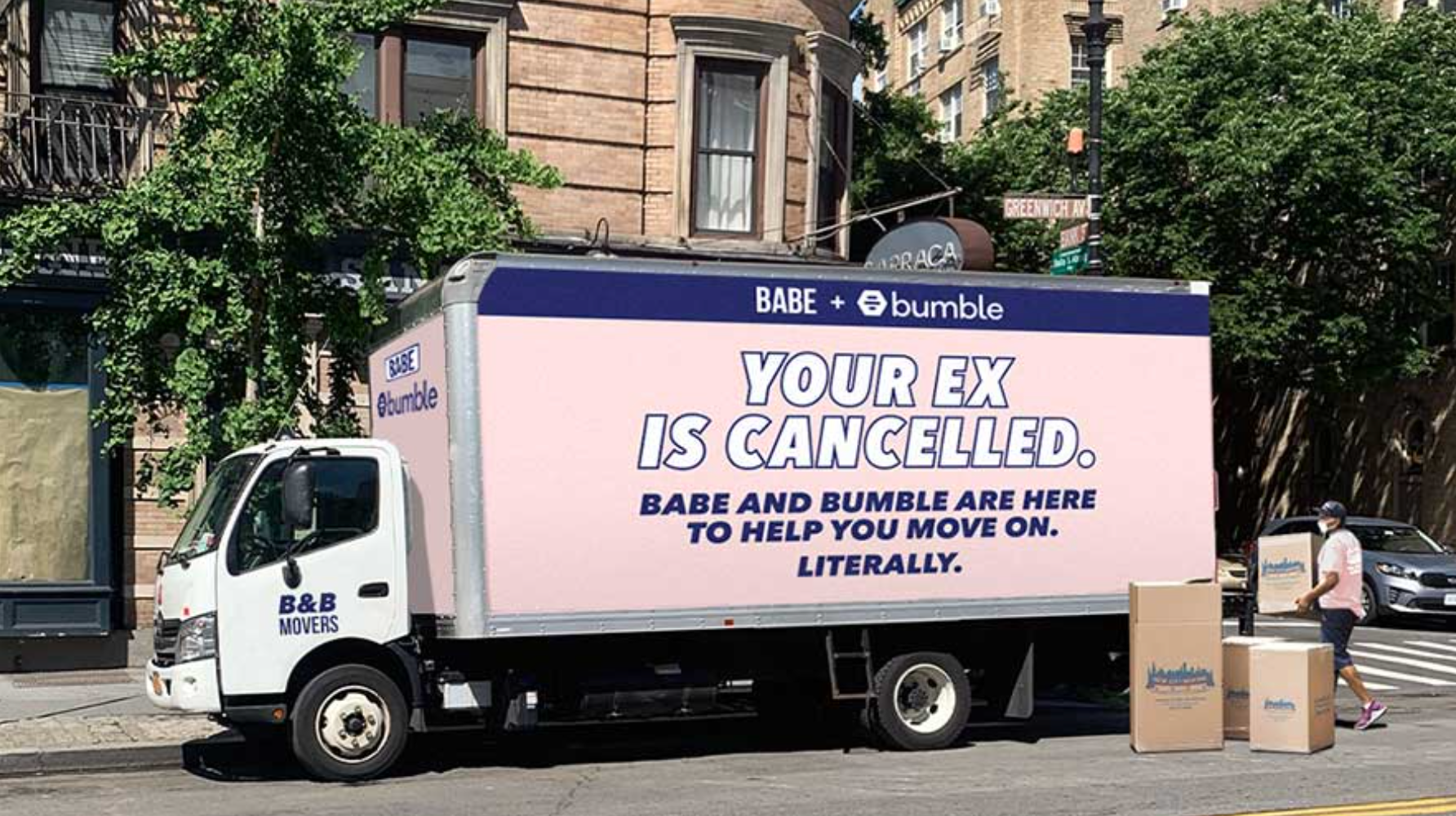
Babe and Bumble mocked up a moving company called B&B Movers using BABE’s brand color identity. Though they are not a real moving company, they made the truck that will come to the rescue.
They are equipped with a pink truck that reads: “Your ex is cancelled. BABE and Bumble are here to help you get a move on. Literally.”
Partnership across industries in the pandemic
Find the right partner
Bumble and BABE could make synergy right because they sell different things to similar audiences.
Bumble is popular among Gen Z(age 18-24) or millennials(age 25-34) rather than older generations(see the chart below). And the campaign with Bumble is another chance for BABE to reach young people. The market of canned wine is growing around the younger generation: the young consumers who seek convenience and value consistent are their main customers(Wine Spectator).
Source: CIVIC Science
Like any relationship, it’s important to make sure your partner doesn’t aim for your share while sharing the same target audience.
Why they targeted Instagram users
According to the Pew Research Center, there are substantial age-related differences in platform use. This is especially true of Instagram, which are used by 67% of 18- to 29-year-olds. Those ages 18 to 24 are substantially more likely than those ages 25 to 29 to say they use Snapchat (73% vs. 47%) and Instagram (75% vs. 57%). According to Mobile Marketer, American consumers aged 18-24 are most likely to engage with the social media campaign, followed by those aged 25-29. Therefore, Instagram was the most accessible platform for the two brands to meet their target audience.
As Instagram users tag themselves on promotional post, the brand could extend the campaign’s reach new customers who share their interests with friends and followers.
Zero waste, which has recently become a global trend, originated in the early 2000s. Then, from around 2010, named influencers and US media began to focus on the zero waste Movement, stressing the importance of environment-friendly lifestyle.
For the Zero Waste Movement, the zero waste shop is a symbolic space. Zero waste shop refers to a shop that minimizes the use of packaging materials and environmental pollution while selling products or services. The idea of buying a product that has less impact on the environment is already becoming the norm. Posts related to Zero Waste are also increasingly emerging on social media. The number of users are growling who share their local zero-waist shop, know-hows and tips, or useful products.
As more people are interested in environmental issues, zero waste shops are spreading too. The number of brands that specialize in zero-waste and produce products is increasing, as more and more people – especially MZ generation, the emerging generation with purchasing power and interests in social issues – are looking for a better zero-waste brand. Or local cafés or restaurants are also jumping on the bandwagon by removing disposable plastics from their stores.
Coffee capsules that you can use without throwing away, Source: Photo by Crema Joe from Unsplash
Buy as much as you just need, Zero Waste Shops
Brick-and-Mortar Zero Waste shops in South Korea
In general, single-use packaging has been widely used in retail industry. Everything we buy are all packaged in plastics and papers that are to be used once, and then be discarded. Additionally, products are being sold in bulk or the amounts per serving is packaged more than we need.
Against these practices that make wastes in product and consumption process, zero-waste shops suggest alternatives. They limit necessary packaging, adopt eco-friendly products without compromising the quality.
Still, the zero waste has just started and there is a far way to gg. With less than 10 stores in Seoul, many people may feel bothered to visit one despite the distance and inconvenience. Plastic-free or eco-friendly living is still a very difficult task, but with some stores or customers who are joining the zero waste journey, it may be possible. And here’s the list of some stores leading this drive towards better.
Almang Store opened in June, 2020. The Korean word ‘Almang(알맹)’ means ‘grain’ because the store only carries contents without unnecessary packaging. Also called as a refill station, they sell oil, spices, shampoo, conditioner, body wash products, detergents and other liquid necessities per gram.
A customer can pay for the amount they only need – one bring their own containers, scoop or pour the desired amount, weigh it on the scale, and pay for the amount they need. A customer pays less than when buying a whole new one. For customers who forgot to bring their own refillable containers, the store lends sterilized containers for those who do not carry any containers. However, they do not provide delivery service.
They also sell eco-friendly products such as bamboo toothbrushes, straws made of glass and stainless steel. And they do more than selling.
They store also collects garbage that is cannot be recycled. The plastic lid, for example. The plastic lids they collect are transformed to a toothpaste squeezer. They also play a role as a local community. For example, they hold workshops and classes for local residents or those who are interested. Recently, they joined ‘Brita Attack Campaign‘, a plastic-free campaign which claims to take back and reuse a water purifier filter(Brita), and hold a recycling workshop on Brita.
Located on a quaint side street in Seoul Forest, the Picker is the first zero-waste shop in Korea that opened in 2016. Started as an eco-friendly vegetarian café, the sell vegan menus – their meals and drinks do not contain cheese and eggs. Soy milk mayonnaise and almond milk are used instead. Vegan dishes include homemade Black Beans Burger, Chickpea Avocado Sandwich, and Banana Nut Open Toast.
They also sell grocery foods, grains, and vegetables. They also carry necessities you’ll need in daily routines: stainless steel, multi-use straws made of bamboo or glass, eco-bags, biodegradable floss, reusable wax wrap, natural loofahs made from dried real loofah fruit bowls made of grain, and the list goes on.
Bottle Factdory Of course, the café Bottle Factory does not provide single-use cups nor paper receipts. Instead, they lend a tumbler to customers who visit without a personal cup. This plastic-free cafeteria offers vegan dishes.
Also, they sell zero waste products including straws, bags, and other co-friendly supplies. Additionally, from 2018, they started package-free refill system. A customer can purchase biodegradable or e cleaning supplies such as laundry detergent and fabric softener.
They are expanding the move further. The CEO of Bottle Factory, Chung Da-woon, developed an app called “Zero Club”. People can download the app and accumulate points when they use zero-waste stores.
If you want to find more…
If you want to explore more stores in South Korea, you can visit here. The site shows a list of refill stations, plastic-free bakeries and cafés. If you are considering plastic-free living or waste reduction, visiting zero waste shops could be a good start. Not only they give you the new brand experience that might lead you deeper into the journey, but also you might find quality products unexpectedly.
Zero-Waste in Fashion
In the fashion industry, which is sensitive to trends and has to constantly come with new designs, has long struggled to get its arms around inventory. To solve this aged problem, the fashion industry is already adopting zero-waste in its deadstock inventory and unsold items.
Established in 2011 by designer Seon-ok Lim, Parts Parts is a designer brand that pursues sustainability. Representative Lim opened the PartsPARTs-lab in Buam-dong, Seoul in 2019. By using recycled materials and removing toxic chemicals generated in the production process, the brand is challenging to wastes.
Parts parts reduce wasted fabric by using only one fabric per product. It uses neoprene made of a material similar to that of a wetsuit. When attaching fabrics, the fabric bonded together using an adhesive method; the fabric is burnt and bonded without using chemicals.
North Face joined the ethical movement by introducing the ‘Eco Fleece Collection’ that recycles 1,082 million plastic bottles, through technological innovation and sincere efforts for sustainable fashion.
Finding that up to 85% of its environmental impact was coming from its own production process, they started to use recycled polyester in outdoor clothes(CountryLiving). Their eco-fleece fabric recycled 50 500ml PET bottles per jacket. Recycled materials from PET bottles were applied to over 100 styles across the entire product line, including clothing as well as shoes and supplies.
The brand also applied biodegradable materials to its products. The representative product is ‘City Eco Soul Down Jacket’. The outer and lining, threads and zippers, and the other complements are made of biodegradable materials, so that it can be completely returned to nature with 5 years of decomposition.
To reduce inventory wastes, the brand started to reform their products. Their gore-tex jackets are reproduced as coats, and men’s suits are transformed into women’s clothing. The important point here is that there is no carbon generation because the stock is reused.
Kolon Industries FnC’s outdoor brand ‘Kolo Sport’, which has been steadily continuing by expanding sustainable eco-friendly campaigns throughout the business, unveils the 7th ‘Noah Project’ in the wake of the 20FW season. The Noah Project, which has been in progress since 2016 to protect endangered animals and plants in Korea, selects one type of animal and plant each season and releases a collection.
Currently, the eco-friendly line Noah Project is applying 100% eco-friendly materials and eco-friendly techniques to all products. They use materials that are recycled from waste PET bottles, nylon, and organic cotton cultivated in eco-friendly methods.
A model wears Noah Collection products. [KOLON SPORT]
Meanwhile, Kolon Sport plans to apply eco-friendly materials or eco-friendly construction methods to half of Kolon Sports’ products by 2023, the 50th anniversary of the brand launch. Stores are also transforming into eco-friendly stores. The brand developed biodegradable hangers and mannequins to reduce the use of plastic in stores.
Patagonia participated in the development of the organic standard ‘Regenerative Organic Certification’ to revive the global environment. (Source: Patagonia)
In 2018, Patagonia organized the ‘Regenerative Organic Alliance’ (ROA), focusing on regenerative organic farming, which can commit to solving climate change problems. Since then, the brand has developed a high-level organic standard renewable organic certification.
They adopted a number of regenerative processes like cover cropping, intercropping(planting other crops between the ridges where one crop is planted) or compost, and absorbing carbon dioxide from the atmosphere into the ground.
Zero-waste in Vegan Beauty Industry
Many beauty brands are adopting organic, zero waste as their brand philosophy. They ban animal testing, avoid chemical substances and plastic packaging, and share know-hows and tips on sustainable action to protect earth.
With the slogan of acting for the environment, TOUN28 is striving to minimize the use of plastic by stably containing cosmetic ingredients in recyclable paper packages that have been tested more than 500 times. They act against animal testing too. Their vegan products do not use animal or animal-derived ingredients, including meat, fish, honey, eggs, and dairy products, and are crafted from plant-based ingredients.
They developed a biodegradable paper container for cosmetic to reduce plastic waste. They also succeeded to develop the world first recycle-labelling paper package. They are still on the journey to make a 100%-biodegradable paper container with no plastic cap.
Aromatica is a vegan and cruelty-free brand that creates efficacious formulas. The products are produced sustainably and are free of synthetic fragrances. Aromatica ensures that its products have the least possible impact on the environment. Their brand mission clearly states “Save The Skin, Save The Planet.”
For packaging, the brand uses recycled glass and post-consumer recycled(PCR) plastic. The brand continuously improves upon the packaging to make it more sustainable. To keep up with its eco-friendly approach, the brand even discarded the use of pump applicators made of polyethylene(PE), polypropylene(PP) plastic and metal springs. Instead, they have switched to using PP flip caps that are easier to recycle.
Why is Zero Waste Movement spreading?
Zero waste movement and branding
As mentioned above, zero waste or eco-friendly moves are nothing new. However, as MZ generations emerged as a new purchasing power, sustainability and ethical consumption has become a new standard. And the growing demands are changing the game, turning over the conventional production and consumption process in ways to minimize the negative impact on the environment.
Increasing numbers of companies are actively recycling resources to capture the MZ generation that pursues ‘value consumption’ such as purchasing eco-friendly products. They publicly support and advocate what they value. the majority of Generation Z(54 percent) state that they are willing to spend an incremental 10 percent or more on sustainable products(Forbes). New York University Center for Sustainable Business(CSB) reaffirms this shift. According to November 2019 Fortune story, CSB found 50 percent of sales growth among consumer packaged goods (CPG) between 2013 and 2018 came from sustainability-marketed products, despite the fact such goods account for just under 17 percent of the market.
Sustainability: A key strategy to brand survival and grwoth
Plastic free challenges that have swept the social media also indicates how many young people are interested in environment issues. Vegan craze and eco-fur consumption share the same context. Pursuing sustainability is no longer niche. With this changes, many brands hopped on the bandwagon of zero waste. Now, sustainability has become a vital element for survival for many brands.
Curation has transformed the ways we get information and goods. As tons of new contents are being created over and over, content curation becomes wide-spread.
The word “curate” comes from the Latin “curatus,” the past participle tense of “curare,” which means “to take care of.” Over the decades, the word “curate” has spread around museums and exhibitions. Then it became a buzzword as the content marketing has boomed as a marketing strategy bible.
The boom of content curation
The term ‘choice disorder(hamlet syndrome)’ was once popular in South Korea. When there are too many options to choose, we feel burden and often end up giving up to make a choice. Now or then, it is unchanging fact that too many choices overwhelm us.
The overflow of information has brought the age of curation forward. With tons of information to process, we want to get the most relevant and quality information from the experts.
There are many curation services that provide the most relevant information we need. Like the daily e-mails you read every morning while you commute.
Curation, how they gained popularity?
Why has the curation services gained popularity?
First, customer demands. Because there were demands, there were supplies. Second, and more importantly, the entrance barrier for suppliers got lowered. Now, anyone can be a curator, and any goods or services can be curated. Third, the demands for convenience helped curation services to combine with subscription economy, developing the curation model with higher sustainability.
Along with these customer needs to save time and energy, the domain of curation has widened; curation is not a exclusive domain for journalists or brand shops anymore.
First, the provider has decentralized. Anyone or any companies can be a curator, as there are lots of platforms to use. We can make and share our voices to the public through many channels at any time.
Many B2C companies provide recommended lists based on our behaviors or through AI algorithms. With the help of AI, the content curation is getting more sophisticated and personalized. Sometimes, when Spotify or YouTube recommend the audio or video clips, they seem to know me better than I do.
Content curation is becoming ubiquitous
Supplies surge where the demands are strong. The ecommerce market is getting more competitive. Many companies have introduced curation services. Also, similar curation services have emerged in many areas – news, books, e-mails, music, clips, photos, places, meal kits, job searches, clothes, health items, stationery goods and all the objects you consume.
Now, curation services have moved beyond the tangible goods to intangible services. Medical services that perfectly suits to my health conditions, cloud gaming services, leisure sports services…the list goes on ad on. They are still evolving in all kinds of areas, and it won’t be long until we find the curation services all over the place to save our time for scavenging.
Curation met subscription economy
Trusted curation services often become workable financial model. Subscription models are representative – monthly flower subscription, monthly book delivery, weekly wine subscription… Many curated services has settled with subscription. You might subscribe more than a couple of services.
Some companies send you the boxes filled with curated products. They are automatically delivered to your door. Or some companies provide you the movies or TV programs of your favorite genre. They simplify the selecting and buying process while meeting personal preferences. The beauty of simplification; the service provider “takes care of” all the hassle, and we just enjoy!
Still, we need to make choices
Instead of spending time to search for something useful, now we often spend time to choose which curated services to use. Now, even new subscription brokerage platforms appeared, which allow you to see at a glance various subscription services at once. Still, we need to make a choice to select the right one among selections.
It has been a few years since content curation and subscription economy became a new normal. And this new paradigm of consumption will last for years. We, consumers, will open our wallets as long as the curation services reduce the burden from the buying process.
In the digital age, it is often said that the print industry is going downhill. But still, professional magazines have been solid over years, being beloved by many. Plus, unlike the past, magazine is not exclusive for a few editors and journalists anymore. Various independent magazines have appeared, and brands are competitively publishing their own print and digital magazines.
But why do brands make magazines?
First, in the age of saturated digital media, high-quality paper magazines is an outlet that brands can differentiate themselves. The look and feel of printed text and images is way different from that of digital. Second, a series of curated content that a magazine contains helps attract customers.
Still, there are questions. Do the brand magazines really sell? Yes – because they provide informative and valuable knowledges that suit their customers. Plus, many magazines showcase artistic graphic design that are visually attractive. Then, let’s take a look at some prominent brand magazines.
The Furrow
by John Deere
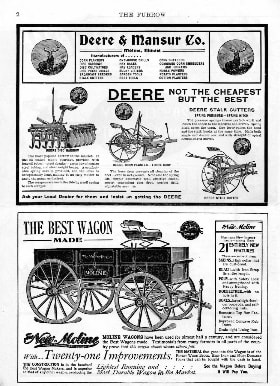
John Deere <The Farrow>
John Deere, a blacksmith in Vermont, USA, founded the agricultural magazine The Furrow in 1895. When there was no word for marketing, The Furrow was the only agricultural curation magazine with 4 million subscribers in 1912.
In fact, there is only one reason John Deere created The Furrow. It was ‘to sell a tractor’. However, since the first issue of The Furrow, John Deere’s tractor has not been publicly promoted. However, they continued covering audience-focused topics that might interest farmers, from the latest agricultural technologies to a guidance of how farmers grow as entrepreneurs. Their content goal was to make farmers more prosperous, not to advertise their products. Ironically, it was how they could make money – educate their customers about new technologies and give advice to solve problems they have.
As a result, even without advertising, John Deere’s tractors sell more and more year after year. For farmers who are already consumers, John Deere has established itself as a leading agricultural machinery brand. With over 2 million subscribers worldwide, The Furrow still prints almost every publication for its enthusiastic readers.
The Red Bulletin
by redbull
Source: Red Bull
Red Bull have linked the concept of energy drinks to sports and adventure. It sponsors various competitions, organizes events, produces various contents, and also directly operates media that covers high-quality content.
Their magazine started as a guidebook that shows the result of the F1 match. Red Bull was the main sponsor of the Formula 1 competition in 2005. At the time, Red Bull set a simple goal of providing a printed guide with the results to Formula One fans who exit immediately after the match.
Two years later, Red Bull decided to develop this F1 publication into a lifestyle magazine. The magazine was published in five countries under the name “Red Bulletin”, with 70% of global articles and 30% of each country’s local articles. The focus moved from people who love extreme sports to people who pursue extraordinary achievements and adventures. Called visual storytelling, the magazine provides powerful visual images and curates various topics related to their audience’s interests.
Now with expanded content portfolio, the Red Bulletin features sports, culture, music, nightlife, entrepreneurship and lifestyle stories every month. Now, 2 million monthly publications are issued in 11 countries, making the magazine one of the most popular brand magazines in the world.
F
by Baemin / Food Delivery Company
If you are a Korean, you’ve probably heard of <F>, a magazine published by Baemin. Baemin is a food delivery service company, which is known for B-class sense of humor and outstanding marketing attempts.
Magazine <F>
In March 2018, Baemin published its first issue of ‘Magazine F’, a food-based magazine. They made an experimental attempt create a cultural fandom, with the stories of food and people.
Magazine <F> covers one ingredient per issue. The stories include history of food ingredients, industry, city, culture and people – any topics related to the ingredient. The magazine serves a perfect guidance for readers with a bunch of valuable information processed from interviews, academic manuals, and researches. After reading this magazine, you will realize that Baemin is not just a brand that pursues B-class popularity.
Directory
by Jikbang / Digital Real Estate Agency
Source: Jikbang(직방)
Jikbang is a digital real estate platform. With Bold Magazine, the brand publishes a magazine that focuses micro aspects of individual living experience. Their magazine <Directory> records the humanized, personal stories of a couple of millennials living in studios, shared houses, or small apartments.
The interviewees – millennials, their targeted audience – featured in this magazine are ordinary like anyone of us. Their individual life isn’t that different from ours, but the magazine focuses on the meaning given to each space in which they live and their tastes blend. Rather than seeing the house as an investment for the future, the magazine perceives it as the space where people live and love.
Through the magazine that contains stories of personal living experience, Jikbang has taken a step further as a lifestyle brand beyond a platform that merely serves as a real estate agency.
Print magazine as a marketing medium
Other brands such as Airbnb, Metropolitan, Intelligentsia also have published paid magazines over years. Brand magazine is often used as a tool to communicate and engage with their targeted audiences. Curated with customized stories, magazine helps the brands to attract public attention naturally and provide more opportunities for audiences to explore more about the brand. Furthermore, it becomes a medium to form a fandom or community.
But there’s one premise – whether it’s digital or printed, the content should be written from a audience perspective.
According to a report published in 2015 by online marketing consulting firm Kissandra, 93% of parents said their children affect family spending and household purchases.
In a 2016 study by Marketing Vendor Interaction, 70% of parents reported that they listened to Gen Z’s advice when buying items online.
The decision makers influence all over the area. According to the IBM Institute for Values, for food and beverage, 77% of parents are affected by their Generation Z children. 76% for households, 66% for travel, 61% for electronics, and 60% for clothes and shoes.
Source: Uniquely Generation Z, IBM
As above, if Gen Zers are powerful opinion leaders or will be, what are the characteristics you must remember when marketing?
3 major characteristics of Gen Z
Value-oriented
The quality of a product or service and brand value are still important to Gen Z, but they more actively link the value to social responsibility. According to a survey by US consulting firm Futurecast, 60% of teens said they would consume brands that are faithful to their social role.
Then, what is the social role of the brand that Gen Z considers particularly important? According to the IBM Institute for Value, the keywords of Gen Z’s favorite brands are eco-friendliness, high quality, and social responsibility.
According to former Wall Street analyst and Forbes top 8 investor, Mary Ricker, Gen Z prefers a brand that advocates environmental protection, child relief, fair trade in the production and sales process of products, and creates pleasant content in the process of using products.
If a particular brand has had a negative influence on society, they also actively boycott. Gen Zers, the most socially conscious generation, put their money where their values are; look at Patagonia, Reformation or other fair trade brands.
Gen Zers prefer mobile
2) They’re protective of their privacy
Gen Zers love to share personal experiences on social media, but they’re also keen to protect their privacy.
Cyber-savvy Gen Zers have witnessed many cyber hacking crises and have learned the importance of privacy and security at schools. They’re more inclined to cover the webcam on their laptops and install ad block than previous generations.
But, according to IBM’s survey Uniquely Gen Z, 61% would feel better sharing personal information with brands if they could trust it was being securely stored and protected.
Companies should be transparent regarding data collection and use. Policies on privacy and security should be accessible, and a company should show how much they care for their privacy..
3) Digital natives shop in offline stores as well
Source: @cardmapr, Unsplash
Despite Gen Zers often use web browser for shopping, they still love browsing in store. According to CSA, sixty percent of Gen Z shoppers still prefer to purchase in-store, and 46% will still check in store to get more information before making an online purchase. In the U.S., 77% of Gen Z respondents said that brick-and-mortar stores is their preferred shopping channel.
They love “real” experiences, even waiting in a long line to buy limited-edition products. This is why many brands focus on building omni-channel shopping experience for customers- linking Online to Offline, which connects social media browsing to actual purchases.
Source: Uniquely Generation Z, IBM
In search of authentic brands
From 3 characteristics of Gen Z above, the things they love can be expressed in one word: authenticity.
The authentic brand that value social causes
The authentic brand that really cares customer privacy
The authentic experience that they can directly see and feel
In the book “Marketing to Gen Z” written by two authors, Jeff Fromm and Angie Read, describes Gen Z as a prudent consumer, a generation that acts with the belief of ‘changing the world’.
As a prudent consumer, they rather believe their friends or other buyers than influencers or celebrities. Keep themselves consciously away from marketing hype, they choose authentic brand or at least the brands they feel so.
Gen Z, the most smart & tech savvy generation, can easily detect whether the brand is authentic or not. They distinguish paid and organic reviews with a few hints. And the words and reviews of those opinion leaders spread quickly on social media and affect others’ decision making.
In the world where authenticity rules, the brand needs to be perceived as reliable, respectful, and real. Building authenticity include transparent communication, dedication to social causes, active social listening and feedback, keeping promises. To raise credibility, consistency can only help. No shortcuts.
Social media is a place where people talk about brands, products, and their interests. And tons of posts and comments are produced every day. Then how can we track related conversation in real time to better attract customers and make informed decisions?
Social media analytics is “the art and science of extracting valuable hidden insights from vast amounts of semi-structured and unstructured social media data to enable informed and insightful decision making.” (Gohfar F. Khan, Seven Layers of Social Media)
Why social media analytics is crucial?
Social media analytics help businesses to make better-informed decisions. Insights drawn from social conversation data might help them assess brand positioning, identify audience preferences, spot trends, and make better-informed decisions. Then how can we collect data and extract valuable insights from them?
Understanding the fundamentals of social media analytics
Step 1. Social Listening
Social listening, or in other words – social media monitoring, is a process of tracking and gathering what the audience is saying on social media. You can collect data by searching content that contains exact word phrase, hashtag or keyword.
Voice of Customer(VoC): Voc analytics is often used to understand the customer experience or buying patterns, or manage brand reputation. Verifiable real-time VoC analysis can provide timely and insightful information about a brand or a product, and enable it to adapt quickly to ever-changing market conditions.
When conduct a social listening, it is crucial to consider the social context, as following the numbers of engagement metrics might be misleading or don’t provide useful insights. In spite of its difficulties that stem in nuance, subjectivity, and idiosyncrasies, text data can provide deeper insights as it contains meaningful information such as sentiment, trends, or customer feedback.
Step2. Text mining
The primary methods of finding information from social media is text analysis. To monitor sentiment and public perception about a brand or a product, you can start with mining text from social media posts, emails, blog posts, comments or any text-based content about the brand/product.
Text Analysis APIs: Buy or Build? To process text mining, you don’t need to be a coding expert. There are SaaS APIs to help you with text mining, and these tools can be a good start to guide you: Google Cloud NLP, MonkeyLearn, Amazon Comprehend, Lexalytics, IBM Watson etc. Or, if you are familiar with machine-learning and want a free and customized model, you can use open-source libraries such as Scikit-learn, Scikit-learn, SpaCy , TensorFlow etc.
Step 3. Text classification and text extraction
Text classification is the process of assigning categories to unstructured text data. Most common text classifications are sentiment, topic and intent.
Text extraction is the process of obtaining specific data from unstructured data. You can extract things like keywords, prices, company names, and product specifications from text-based content.
Thanks to machine-based automation, it is possible to classify and extract texts at a large scale in a short time. There are two available solutions for the analysis of unstructured data: machine-automated NLP and machine-learning.
Machine-automated natural language processing(NLP): this approach uses a machine to understand the human natural language. Natural Language Processing helps machines read text, by simulating humans’ ability to understand languages. Today’s NLP has developed to process a comprehensive context, decipher ambiguities, or domain-specific ontologies.
Machine learning-based analysis: this analysis helps discover distinctive patterns from comprehensive data by training with examples. Through this analysis, the models can be altered and adjusted to adapt to new conditions that weren’t anticipated. Machine learning models can capture comprehensive context because they rely on applying patterns using probability and statistics.
For example, machine-automated approach can help you analyze the general sentiment of social media posts – whether they are positive, neutral or negative. To make this analysis even further to discover why, you may bring machine-learning analysis and find the reasons for the sentiment. For instance, you can learn whether the feedback about the product is due to customer service, product quality, price, or its packaging. However, there is still limitations; for instance, sarcasm or ironical parodies can be hard to detect or distinguish with sentiment analysis.
Step 4. Data visualization
After data are collected, the data set need to be visualized so it’s easy to understand and clearly illustrate the result. Frequently used visualization tools include: Google Data Studio, Tableau, DataHero, Qlick Sense, Visme, D3.js. To visualize a set of data effectively, you should be able to choose the right visual to your purpose or goal.
There are many pieces of advice about how to make visualizations that really work. You can refer to the link below or find more information yourself. But the most important point is, you should make your visual comprehensible and straightforward. For this, it’s also a good idea to start with designing the visual with your own hands – drawing.
Step 5. Find insights and use them before its novelty wears off
Automated analysis has become a powerful tool that helps businesses gain actionable insights from their text data. One more thing: if you attained useful insights from the extracted data, it’s also important to implement data-driven strategies PROMPTLY. As data have a limited shelf-life, it’s crucial to use the insights before the values vanish.
McDonald’s, the biggest fast-food chain in the world, is easily recognizable with its logo. With its long brand history beside us, we can easily spot the brand even with small parts of its logo. Their ads won awards and got viral over and over. Here are some best practices that might help you earn insights.
McDonald’s Czech Republic used the Arch to stress “safety” while driving. The Arch is repurposed as a part of a visual that demonstrates the safety guidelines for a driver.
McDonald’s in Brazil separated the brand’s iconic Golden Arches.
Against the coronavirus pandemic, McDonald’s Brazil has split its Golden Arches into two to promote and encourage social distancing. According to the brand, the separated logo conveys the meaning that “we are separated for a moment so that we can always be together”. (AdAge)
I’m Lovin Summer (DDB, Sydney, Australia)
Summer is the beloved season in Australia. It’s also the season for water sports, ice cream, and outdoor activities. In the ad, McDonald’s combined their logo with summer items so that consumers can remind the brand with summer.
The ad is comprised of four pieces: “Next Exit”; “Just Missed Us”; “On Your Left”; and “On Your Right”. The Arch in the billboard ads is cur part to guide hungry motorists to its nearest outlet.
The sand lock falls down for 12 hours, the period of fasting. The fell grains slowly compose a McDonald’s meal. After 12 hours, customers can break the fast and enjoy the meal.
French fries become a signage to guide direction. With its minimalism design approach, McDonald’s French fries are transformed into directional arrows.
McDonald’s promotes the late opening of its restaurants with their food image. Fries and hamburger buns are used t o illustrate different phases of the moon.
The golden arch shapes the tired and wide-open eyes. The comparison shows that McCafe can help you beat tiredness.
If you see the signs, you are probably hungry(DDB Athens, Greece)
The Arch dimly shows up in the poster. City lights, traffic back lights, skid marks form the Golden Arch. This ad tells that when you are hungry, you see the things that you crave.
In celebration of July 1, or “Moving Day” in Quebec, McDonald’s came up with an ad that shows the rear view of a wide-open truck. Furniture and household items compose best known dishes of McDonald’s – Big Mac, Mac morning, and fries.
The design is simple, but the image that the ad casts is vivid. The color and shape of stacked phones reflects something that we know well – bic Mac, fries, and mac morning. This ad tells us that when you need McDonald’s, you can have them at your hand.
Consumers often don’t believe all of marketers’ words. They have negative attitudes towards the motives of or claims made by advertisers.
According to a study conducted by Calfee and Ringold(1994), 70% of consumers thought that advertising persuades people to buy things they do not want. Another study done by Mangleburg and Bristol(1998) found that adolescents who learned more about advertisers’ persuasion tactics became more skeptic about advertising.
Advertising, Too many and too intrusive
Consumers, or we, are invaded by annoying digital ads and push alerts daily for uncountable times. This makes consumers more tired of and doubtful about brands in self-promotion. Advertised content seems meaningless or even untruthful.
This lays paradox. Consumers – especially Millennials and Gen Z – sometimes doubt well-advertised brands or their products. When brands create more buzz through influencer marketing or media advertising, they could make negative impact on some consumers.
The problem is, doubtful consumers not only trust ads, but also eliminate the chances of ads to win impression in the first place. According to PageFair and Blockthrough, more than 527 million people around the world have an ad blocker installed on their mobile devices, up 64% since 2016(Blockthrough).
Gen Z consumers are more skeptical
According to a new national survey by BBMG and GlobeScan, by a 5-to-1 ratio, the leading edge of Gen Z does not trust business to act in the best interests of society. They often disregard brands that do not offer a genuine connection.
Think of recent criticism against Apple’s decision to opt out wall chargers and earbuds in its new iPhone 12 boxes. Though Apple claimed that they decided to exclude chargers and earbuds to reduce mining, packaging, and carbon dioxide emissions, many criticized their decision to ditch chargers was only to save costs, not the planet.
Key to win trust from doubtful consumers
Skeptical consumers are less likely to rely on advertisement, but they buy others’ words. They rather put value on reviews, not what the brand says. This is where organic content comes in: let consumers talk, not the brand.
UGC(User-Generated Content): Leveraging the voice of consumers, UGCs can help a brand or product seem more authentic and credible, thus influence their attitude towards brands or purchase decision. For example, Airbnb uses stories from hosts and travelers to engage their audience more authentically.
Native ads: In other words, native advertising is paid content. The company pay for the content, but the content is well aligned with contextual style and tone, or provides useful information that consumers are seeking. This is what makes native ads hard to spot.
Become genuine
Consumers become smarter and smarter. We can compare the product quality, price, reviews in real-time, and easily detect whether the brand is lying or telling the truth.
The good point is, when consumers truly resonate with the content, they share it voluntarily. This user-generated content will produce another one, generating bigger influence. A simple old rule goes same in the marketing strategy. Be trustful to win trust. And happy customers will become your own influencers.
A study by ad fraud verification company Cheq finds the amount of money lost will overtake credit card fraud in 2020. They expected digital ad fraud would hit $35 billion this year.
They are not only one who says this. The WFA predict ad fraud will become the biggest market for organised crime by 2025, worth $50 billion. The total cost of ad fraud is in debate, but the general idea is that the digital ad fraud will increase.
Fraud has raged as digital ads developed. Click fraud started in 2000s and hit ad campaigns in until 2010s. Until recently, bots or device farms are among the most prevalent forms of ad fraud.
Bots/emulators – using the same principle as device farms, except using devices which are not real, making the resetting process easier, though leaving behind a similar suspicious pattern.
Device farms – the use of real devices to click on ads and install apps, after which they are reset and the process begun again. This creates a suspicious pattern, which can result in ad fraud detection.
However, as Mobile Measurement Partner(MMP) — an independent third-party platform that tracks and analyzes attribution data – was introduced and started to gain popularity, simple frauds like device farm were detected.
Since then, fraudsters started to make a interception manipulate a real user’s data, instead of using bots or device farms. Now the fraud techniques became more complicated and they often act like a real user.
Types of mobile ad fraud include:
Click spamming (click spamming, big click) — simulating a high number of clicks from real devices in order to get the credit for organic installs then made legitimately. It generally creates long CTIT (click-to-install-times), high CTR (click-through-rate) and low CVR (conversion rate).
Click injection — a fraudulent app creates fake clicks when app installs are taking place, claiming the attribution for the install. In this case, it generates short CTIT , high impression and low CTR.
SDK (software development kit) spoofing — fraudsters create a bot within an app which then sends clicks, installs, and engagement to the MMP (mobile measurement partner) which registers them as if they were genuine.
Pixel stuffing — When fraudsters use pixel stuffing, they’re presenting a larger ad in a space so small it’s undetectable. And even though visitors don’t see it, the fraudsters get credit for the impression. What’s worse, this method can be repeated countless times on a single page
Cookie stuffing — Cookies are text files that store information about a visitor’s browsing behavior. These cookies can be hijacked and filled with incorrect information about the visitor. It’s common in affiliate marketing, where marketers partner with a brand to advertise their product.
Domain spoofing — a common form of phishing, occurs when an attacker appears to use a company’s domain to impersonate a company or one of its employees. This can be done by sending emails with false domain names which appear legitimate, or by setting up websites with slightly altered characters that read as correct.
Display fraud (display impression fraud) — a class of fraud where criminals defraud advertisers and networks running CPM media- usually CPM and Video view campaigns. Common types of displayfraud include ads on pop-unders and ad stacking.
Incent abuse — inducing users to click and install apps. To help hide the high click-to-install conversion rate that results from this, fraudsters might send a high level of fake clicks to help mitigate the suspicion.
Geo masking — Geoblocking technology that restricts access to Internet content based upon the user’s geographical location.
Some say fraud ads lower down the cost. As they expect fraud being priced in, they justify buying digital media, despite knowing there is ad fraud. They’re OK with there being ad fraud, because they got lower prices. But fraud ads not only waste money, but they also dilute the performance analysis. Clicks, CTR, impressions, installs, conversion or any other metrics can be manipulated.
Although the agencies can guarantee the volume, fraud ads are worthless to the marketer. Instead, they are highly lucrative for the fraudster, because the cost is very low(A 2013 study by the Digital Citizens’ Alliance documented just how lucrative ad-supported piracy sites were: 83 – 99% profit margins and millions of dollars)
How to Prevent or Detect Fraud Ads?
Some say accredited social media such as Facebook could be alternatives as they provide custom ads and give you credible results as you can target specific audience. However, occasions happen when a marketer has to reach the audience out from walled garden. In these cases, a marketer should execute ads anyway.
Use automated detection apps
Sometimes, it is said that fraud ads can be prevented with advertiser diligence. Finding the list of IP addresses who are visiting your website or social media pages, “manually”. However, it’s still overwhelming and impossible job for a marketer to detect fraud; what a waste of human resources! Instead, a marketer can use automated apps to optimize installs, in-app events, or in-app purchases, then one can focus wholly on strategy development itself.
And you can find “Top Ad Fraud Detection Tools (2020)” here(Business of Apps).
Work with trusted companies
Verify the partners or publishers with a good repute in the field, before making a contract. Take time to find the right partner that has valid traffic pool, and if you found one, ask them to provide the data transparently.
Use MMPs and deep dive into the traffic
MMP tracks attribution of a campaign or advertising and tells you what ad a user saw or clicked to make a conversion(app installs, app open, registration, subscription, or product purchase). Here are representative MMP services : Singular, AppsFlyer, Branch, Adjust, Kochava
Find and use an MMP (Mobile Measurement Partner) that fits your business model. Look into the data regularly and detect abnormal signals. If you found signals, make adjustment with your attribution setting.















 Ideas for Social Impact