Categories
미분류

Red Bull, beyond a energy drink company

Red Bull, widely known as the originator of energy drinks, introduced energy drinks to the market for the first time. Now they have expanded their fame beyond product marketing.

With its tagline ‘Red Bull Gives You Wings’, the company focuses on the idea that their product gives people the “wings” when people need energy to do what they love.
Red Bull rumoured to cut back on music studios in the midst of internal  racial disputes | Arts
Source: News24

Becoming a pioneer

Red Bull has differentiated their product from existing beverage companies by pursuing to be a pioneer, categorizing the product as energy drink, unlike other caffeinated soft drinks.

To promote their new product, Red Bull distributed samples in places where caffeine consumption was prevalent, such as office buildings, bars, night clubs and gyms, not supermarkets and retail stores.

Targeting young and urban youth

To introducing a new product – energy drinks, the company should newly find their target customers. They are not the middle-aged people, who are the main customers for the existing competitors. Or they even sacrifice a few hours of sleep to enjoy sports or rock festival. In one word, simply, they live young and active.

  • Men between 16 and 36 years old
  • Urban lifestyle
  • Love extreme sports, gaming, music or active lifestyle
  • Adventurous, active

As their target is newly defined, accordingly, the company tailored their content to their target audience.

They focus on topics like extreme sports, music, art, dance and whatever people become enthusiastic. Because of that broad spectrum, their content cover various topics and can appeal to the right audience.

Engaging with sports lovers

Motoring | Red Bull Motorsports
Source : Red Bull

Sponsoring major extreme sports

Setting themselves as a highly ego-expressive product, Red Bull embraced extreme sports as their marketing strategy. This helped them to engrave their presence to the public. Red Bull acquired the existing Jaguar F1 Team in 2005 and re-founded it as the Red Bull F1 Team. As an emerging powerhouse, the team climbed to the second place in 2009, showing off their presence.

The biggest reason Red Bull invested in the F1 racing team was to increase its brand awareness and promote sales through F1.  The marketing effect of F1 is known to be particularly effective in Europe, where F1 is popular.

Now Red Bull owns and operates four international soccer teams, two Formula 1 racing teams and 1 hockey team.

Sponsoring minor sports

Plus, Red Bull also sponsors not well-known or unique sports such as street basketball, mini-drome, motorbike, surfing, mountain bike, skydiving, etc. Red Bull also hosts extreme sports competitions such as Redbull Rampage, MTB, Red Bull Air Force etc.

For example, the mini-drome is an ultra-mini cycle game played in a place where the existing cycling stadium, velodrome, is down-scaled to a tenth. In other words, the average circumference of the cycling stadium is 250m, but the mini-drome is 14m long and 7m wide, so you can enjoy thrilling and exciting games.

Red Bull Mini Drome: Tokyo
Source: Red Bull

These events and sports stories are fully covered on their website, which attracts their target customers visit pages and engage with the branded content. Surprisingly, each quality content has no mention of their product.

Challenging to limitations

Source: Red Bull

Red Bull continued making bold moves even in inaccessible area: Red Bull aired the supersonic free-fall experiment called Red Bull Stratos. In this project, the skydiver goes up to 120,000ft (36km or 24 miles) from the Earth surface, then freely falls and breaks at the speed of sound. Through the camera attached to the skydiver’s body, Red Bull aired all information including the current height, falling speed, and skydiver’s heart rate.

This historic project, which challenged human limitations, attracted attention and the streamed YouTube video captured 8MM+ concurrent viewers.

Expanding their realm – Culture marketing

The Red Bull expanded their sports marketing to culture marketing, involving various playgrounds of music, dance, art, and social innovation. They have soared into pop culture and extended their reach to meet more customers.

For years, Red Bull has executed culture-focused marketing initiatives through engaging events at local, regional, and international level.

Dance competition

Red Bull BC One has become one of the biggest breaking competitions in the world. Every year, thousands of breakers compete in the tournament for a chance to represent at the Red Bull BC One World Final.

Red Bull also holds “Dance Your Style” competition every year. Recently, it collaborated with a video-sharing app TikTok and transformed it into a virtual event. 

Music

They’ve moved into the music realm too. In addition to covering or sponsoring massive musical festivals, Red Bull also boasts it’s own record label, recording studio, music academy, publishing group, and online radio station.

Red Bull's Home Page
Source: Red Bull

Achievements

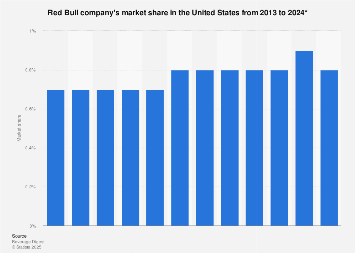
With the success of such brand marketing, Red Bull’s sales have grown steadily. There was also a crisis of some sales declines, but its gradually expanding its market share.
Red Bull company's U.S. market share 2019 | Statista
Source: Statista

Key Takeaways

Creating content around what their audience Loves

Energy drinks are also not recognized as high-performing product before. As a result, there is a growing possibility that consumers will not accept the brand value that Red Bull pursues.

However, Red Bull has used its edgy business model to establish itself as a sports marketing powerhouse. Transforming into a culture marketing-focused brand, Red Bull now produces magazines, TV programs, online videos, music, photos that feature relevant topics.

Every piece of content that they create matches the quality of other publications their target audience might read like Buzzfeed, Vice, ESPN, and more. For example, They produce a magazine, The Red Bulletin, which circulates over 2.2 million copies a month. The online videos are reviewed as awe-inspiring, and same for photos.

Red Bull’s consumable content thoroughly revolves around their audience’s interest. Having transitioned from an Austrian energy drink company to a global lifestyle brand, Red Bull was able to make an impressive brand image that their target customers love.

Categories
미분류

4 Best Content Marketing Practices – Give what customers want

“Give to get” – this simple trading strategy is also applicable to the marketing world. Companies want customers attention and their loyal affection. Customers want the valued information they are looking for.

Here are the best practices of companies that mobilized this simple strategy. They gave customers relevant content of their interests, and got their affection in return.

1. Red Bull

Red Bull branded their content with a strong focus on their customers. Their website is full of content related to extreme sports, gaming, music, leisure sports, and anything else that might capture the attention of their target audience.

Public Relations – Red Bull's Content Marketing Strategy

Red Bull mobilizes all media they can fetch(videos, social media, blogs, images, magazines, TV, etc.) to provide the interests of customers. It’s a bold and genius way to capture the attention of their target audience, instead of direct promotion of their products. 

RedBullContentPool.com is another way that Red Bull cares their customers’ interests and lifestyle. They provide high quality stock photos and videos for editorial use, by publishers, news agencies, TV stations, etc., often with a Red Bull logo embedded.

Red Bull Marketing Strategy: What You Need to Know + How to Copy It

2. John Deere

Farm Collector Magazine - THE BIGGER BOOK OF JOHN DEERE

Not many people are familiar with John Deere. However, if you know a little about content marketing, you might be familiar with it. This is because it is the progenitor of content marketing.

John Deere is a brand of Deere & Company, an American company that manufactures axles, transmissions, gearboxes and lawn care equipment for use in agricultural, construction and forestry machinery, diesel engines and heavy machinery. This industry doesn’t seem match well with the magazine.  However, John Deere publishes the agricultural magazine The Furrow, which was first published in 1895.  

Farrow rarely mentions John Deere. It provides information that consumers need and wants to know. This simple fact of providing the information customers need is difficult to maintain in practice. 

3. Coca-Cola

brandchannel: Coca-Cola Puts Fans on the Can in Australia

Coca-Cola mobilized a simple but powerful psychological motivation that everyone has: “I want to be called and recognized as myself”. They selected 150 of the most common names in Australia, so that you can drink your own’Custom Coke’ by engraving it on a bottle of Coke. The reaction of the public was explosive. People fought and bought a coke bottle with their name on it.

After the great success in Australia, Coca-Cola expanded its campaign to the world. The success factor of this event lies in’customization’, which seems to be for each customer. When the public purchased a bottle of cola with their name, they felt as if they had become a special person, which soon led to explosive consumption.

4. Buffer

3 Simple Lessons from the Success of Buffer's Blog - MobiLoud

Social media company Buffer is known for its radical approach to transparent communication. They even shared salaries of all 71 employees, posting them on a public website. Buffer employees reveal themselves and post writings on private stories such as their personal experiences, corporate culture or problem-solving methods that Buffer uses for clients.

Buffer’s open blog contains simple but powerful keywords of trust, openness, and communication. Those who know the blog can get detailed information on how the buffer works. It feels as if you are part of a secret club that shares high-quality information.

This psychological effect is called the velvet rope effect. When you go to the club, you’ve probably seen velvet ropes wrapped around the space for VIPs to limit access. A space only for the chosen people, which seems to be invisible. People are enthusiastic about the fantasy the velvet rope gives, and they dream of being included in the space beyond.

Buffer’s open blog is the VIP zone beyond the velvet rope. The best VIP zone that explains customer’s curiosity in detail inside the company.

Takeaways

Always focus on creating value for your customers. Share valuable information that cannot be easily found or only you can provide.

Categories
미분류 Marketing

Social Media Analytics – Text Analysis

Social media is a place where people talk about brands, products, and their interests. And tons of posts and comments are produced every day. Then how can we track related conversation in real time to better attract customers and make informed decisions?

Matrix movie still
Photo by Markus Spiske on Unsplash

What is social media analytics?

Social media analytics is “the art and science of extracting valuable hidden insights from vast amounts of semi-structured and unstructured social media data to enable informed and insightful decision making.” (Gohfar F. Khan, Seven Layers of Social Media)

Why social media analytics is crucial?

Social media analytics help businesses to make better-informed decisions. Insights drawn from social conversation data might help them assess brand positioning, identify audience preferences, spot trends, and make better-informed decisions. Then how can we collect data and extract valuable insights from them?

Understanding the fundamentals of social media analytics

Step 1. Social Listening

Social listening, or in other words – social media monitoring, is a process of tracking and gathering what the audience is saying on social media. You can collect data by searching content that contains exact word phrase, hashtag or keyword.

  • Voice of Customer(VoC): Voc analytics is often used to understand the customer experience or buying patterns, or manage brand reputation. Verifiable real-time VoC analysis can provide timely and insightful information about a brand or a product, and enable it to adapt quickly to ever-changing market conditions.

When conduct a social listening, it is crucial to consider the social context, as following the numbers of engagement metrics might be misleading or don’t provide useful insights. In spite of its difficulties that stem in nuance, subjectivity, and idiosyncrasies, text data can provide deeper insights as it contains meaningful information such as sentiment, trends, or customer feedback.

Step2. Text mining

The primary methods of finding information from social media is text analysis. To monitor sentiment and public perception about a brand or a product, you can start with mining text from social media posts, emails, blog posts, comments or any text-based content about the brand/product.

Step 3. Text classification and text extraction

Text classification is the process of assigning categories to unstructured text data. Most common text classifications are sentiment, topic and intent.

Text extraction is the process of obtaining specific data from unstructured data. You can extract things like keywords, prices, company names, and product specifications from text-based content.

Thanks to machine-based automation, it is possible to classify and extract texts at a large scale in a short time. There are two available solutions for the analysis of unstructured data: machine-automated NLP and machine-learning.

  • Machine-automated natural language processing(NLP): this approach uses a machine to understand the human natural language. Natural Language Processing helps machines read text, by simulating humans’ ability to understand languages. Today’s NLP has developed to process a comprehensive context, decipher ambiguities, or domain-specific ontologies.
  • Machine learning-based analysis: this analysis helps discover distinctive patterns from comprehensive data by training with examples. Through this analysis, the models can be altered and adjusted to adapt to new conditions that weren’t anticipated. Machine learning models can capture comprehensive context because they rely on applying patterns using probability and statistics.

For example, machine-automated approach can help you analyze the general sentiment of social media posts – whether they are positive, neutral or negative. To make this analysis even further to discover why, you may bring machine-learning analysis and find the reasons for the sentiment. For instance, you can learn whether the feedback about the product is due to customer service, product quality, price, or its packaging. However, there is still limitations; for instance, sarcasm or ironical parodies can be hard to detect or distinguish with sentiment analysis. 

Step 4. Data visualization

After data are collected, the data set need to be visualized so it’s easy to understand and clearly illustrate the result. Frequently used visualization tools include: Google Data Studio, Tableau, DataHero, Qlick Sense, Visme, D3.js. To visualize a set of data effectively, you should be able to choose the right visual to your purpose or goal.

There are many pieces of advice about how to make visualizations that really work. You can refer to the link below or find more information yourself. But the most important point is, you should make your visual comprehensible and straightforward. For this, it’s also a good idea to start with designing the visual with your own hands – drawing.

black flat screen computer monitor
Photo by Clay Banks on Unsplash
Step 5. Find insights and use them before its novelty wears off

Automated analysis has become a powerful tool that helps businesses gain actionable insights from their text data. One more thing: if you attained useful insights from the extracted data, it’s also important to implement data-driven strategies PROMPTLY. As data have a limited shelf-life, it’s crucial to use the insights before the values vanish.

Categories
미분류 Marketing

Audience Targeting

What is a Target Audience?

Target audience is a group of consumers who are most likely to purchase your products or services. Finding a right target audience is discovering what kind of people are most likely to be interested in your services or products. They are likely united by some common characteristics, like demographics and behaviors.

selective focus photography of an arrow
Photo by Ricardo Arce on Unsplash

Why should we identify a target audience?

  • To build a stronger connection : The more you find out about your audience, the stronger connection you can build based on their needs and interests.
  • Enable market segmentation: Specific segmentation allows you to tailor your messages and strategies to the target audience, which leads to the effective use of marketing budget. Identifying social media audience helps you to find your niche market that you can dominate.

You can start with broad categories like millennial generation or female mothers in 20s then narrow down. But you need to target specifically in the end, as there’s no “one-size-fits-all” strategy.

How we can identify the ideal target audience?

  1. Collect demographic data on your target audience

You can start with current customers. You can leverage Google Analytics or Facebook Insights, you can get traffic data and audience analysis. Those tool provide access to demographic and behavioral data, enabling you to learn more about your audience and build ideal personas for marketing strategies.

First, Google Analytics provides information through Audience report about users who visit your website. Largely, 1) information on visitors (potential customers) such as demographics and regions, 2) whether these potential customers are new/revisited and their frequency of visits, 3) access devices such as mobile and desktop, user browser, operating system, etc. For this, you should Install the Google Analytics tracking code on your website, so you can obtain real data about your website visitors.

Or you can collect your audience behavioral data from audience insights or customized advertising on Facebook. Facebook pixel allows you to measure the effectiveness of your advertising by understanding the actions people take on your website. To learn more, you can find more information here(Hootsuite blog).

2. Monitor your competitors and their audience

Or if you have direct competitors, it is possible to look for the target audience among their subscribers on social networks. Or if you want to differentiate your brand from competitors, you can draw a positioning map to find the sweet spot or a niche in the market that you can fit in.

For getting more audience traffic and data, it’s better to optimize your website or social media content with SEO or marketing tactics. Boost your SEO drive for the best keywords of your business and see how those keywords are working. The people who search for your keywords or anything near to your keywords will be your target audience. Then, pick one or two visitors to your website and intensely research on them to create your persona.

Source: hiclipart

How can I reach a target customer?

Step 1. Make sure that you have a focused target audience with right criteria

To find the most relevant audience, you should consider what criteria to use. The goal is to remove the groups of people who are not relevant to the company’s products or services. Audiences can be sorted by any number of ways based on the combination of criteria. With the right people out of the mix, you can approach your customers with more customized and valid marketing messages.

Then, what data should I consider as criteria? Some data points you might want to compile are demographic and psychographic data such as: Age, Gender, Education background, Social class, Location, Profession, Consumption habits, Purchasing power, Likes, Values

All demographic and behavioral data you can compile could be a good foundation source to set your ideal audience. Remember, the sharper the potential customer’s profile is, the more opportunities we have to personalize the messages.

Step 2. Identify what your target audience want most from you.

According to the 2013 online personal experience study, 74% of online consumers get frustrated with websites when its content, offers, or ads have nothing to do with their interests.

This is why you should create marketing strategies and messages that fully address audience’s wants or needs. Today, we are talking about the rise of personalized campaign approach, mainly driven by ad tech. Marketers need to send out messages that appeal exactly to them to win their attention.

Step 3. Choose the best channel to communicate

What’s the best way to reach your target audience? You can start by thinking or surveying how your target audience gets information. You can consider traditional media such as TV, newspapers and radio, or digital media such as websites, organic search, social media or podcast.

Step 4. Measure campaign result to determine if you actually did reach the right audience

Monitor the campaign result, and analyze the real audience data that came into your websites, apps or made a purchase. If the audience you predicted is different from the actual data, then you can tweak strategies for future campaigns to make them more effective.

The benefits of personalized marketing is diverse: improved response rate, increased sales, stronger brand perceptions, increased product trial rates, increased repeat purchase rate and the list goes on. Or in other words, cost goes down and conversion goes up. For this, you should start with slice and dice the data into meaningful insights, and keep shaping the perfect target audiences by making a deep dive into analysis.

Categories
미분류 Marketing

I want it now, Micro Moments

episode 2 love GIF by Making It
GIPHY

Micro-Moments are defined as moments during the day when a consumer instinctively reaches for their smartphone to find, go, do, or buy something. In short, it’s a rich-intent moment that a consumer turns to their device as they need something. In these moments, the possibilities that a brand can win over specific actions from customers are high

Image for post

Brands can create an intimate connection, reaching consumers ate the precise instant when they are ready to know, shop, go, or to buy. Marketers like to call this narrow window, when a consumer is motivated to make a decision, a micro-moment.

Examples of Micro-moment in marketing

Baemin, how they use micro moments to get more reviews

Baemin, a Korean food delivery app, pushes a message that tasks a review when a person who ordered food almost or already finished eating. This is the way the app collects a number of reviews.

A design for Micro-moment, Uber

Uber’s integration in Google maps is a perfect example of how you get information when it’s most needed: “I’m going to Google maps to find a place and it’s very likely I will need transport to get there”, hence Uber’s plugin into Google Maps:

Image for post
Google’s Lyft and Uber integration in Google maps.

Hyundai brought test-drives to your door

Hyundai discovered that consumers struggled to find time to test-drive a car, but test-drives significantly increase the likelihood of purchase. So Hyundai tried an online program that brought test-drives to consumers, either at their home, office, or local hangout spot. It was a huge success, with 90% of customers saying it was the deciding factor that got them to a dealership. (How Hyundai changed course to improve the customer journey. ThinkwithGoogle)

Leveraging micro-moments marketing, there could be yet-to-be-discovered opportunities. And more possibilities to win over users’ or customers’ actions, too! Tap into micro moments for your marketing strategies and make sure your brand be there in these moments of need. 

Source: Think with Google

Categories
미분류 Marketing

How the New York Times demonstrates the pandemic

During the pandemic, the New York Times tried several unconventional attempts to illustrate severe and astonishing aspects of its influence. On its front page, the list of names took over the front page. Or they emptied the nearly one-third of a page to illustrate social distancing.

The New York Times and Social Distancing

Delivering a powerful message with a simple design

The New York Times

The New York Times illustrated social distancing through its eye-catching design. The Times allocated a significant portion to illustrate self-isolation. The design is simple but intuitive, making the message powerful.

You can read the full article here: Wondering About Social Distancing?

New York Times

The paper presented a numerous loss of lives from the pandemic in a solemn way

Dedicating a whole page to the names

In the same month, The Times demonstrated the damage of pandemic in a distinctive way using its front page.

Normally, articles headlines, photographs, information graphics appear on the first page. Especially, photographs and visual graphics come on the front page on Sunday. Instead of these elements, a list of people who lost lives due to the Covid-19 took over the whole front page.

New York Times presented a number of names and memories from obituaries across the country

This was when the death toll from coronavirus in the United States approaches 100,000, and the paper demonstrated this national loss in a solemn way. They gathered names of the dead and memories of their lives from obituaries and death notices from various sources. According to the New York Times, Alain Delaquérière, a researcher, compiled a list of names. Then a team of editors and three graduate student journalists compiled personal data that depict their lives from newspapers and online sources.

You can read the full article here: The Project Behind a Front Page Full of Names

The surge of unemployment

In March, 2020, unemployment claims almost reached 3.3 million due to a widespread economic shutdown brought by the Covid-19. That’s about 5 times more than the number of previous highest unemployment claims, which was 665,000 in March 2009, during the recession.

To visualize this soar, the Times gave its right column to a graphic that goes all the way up to the right side of the page. This soaring graph marks how the economic toll was stark at the moment.

Antonio Arellano on Twitter: "The front page of the New York Times: nearly  3.3 million unemployment claims were filed last week, a record number. The  U.S. now has the most #COVID19 cases
The New York Times

Death toll spiked through the logo

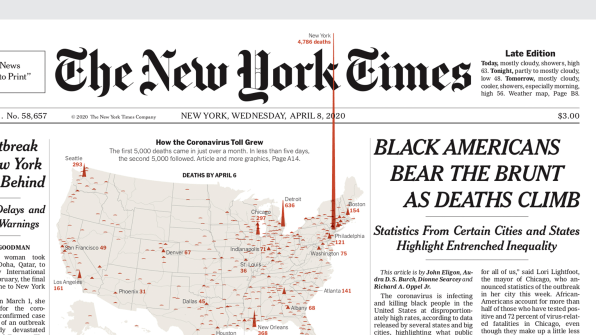
Three thousand more people died in New York City between March 11 and April 13. (The New York Times) When the death toll spiked in New York city, the New York Times mapped the coronavirus toll across the country with spike visual elements. In the map, New York City’s fatailities spiked through the logo, making the focus clearer.

The New York Times

The unconventional graphic presentation, the key to make your content stand out

The well-made design brings into clearer focus the facts and key messages. As seen above, no matter how simple that is, a well-designed graphic tells you the stories behind the text, inspire your thoughts, and deliver the unseen messages.

This is why design has become key for many media content. Even the New York Times utilized their the most precious real estate, the front page, in an unconventional way to grasp reader’s attention and convey meaning effectively.

Categories
미분류 Marketing

Marketing Certificates for Marketers

Marketing learning courses that will validate your ability

Marketing certification is not always required to work, but if you want one, there are many ways to achieve them. You can take a marketing or communication online courses from universities, companies, or marketing platforms. The problem is, there are many options out there and it is hard to figure out what to choose at first sight.

So, I classified digital marketing courses into several groups: Content Marketing, Social Media Marketing, SEO Marketing, Online Advertising, Marketing Analytics, and Others.

assorted icon lot
Photo by Stephen Phillips – Hostreviews.co.uk

Certification for specific digital marketing skills

Content Marketing Courses
  1. HubSpot Content Marketing Certification – HubSpot Academy
  2. Viral Marketing and How to Craft Contagious Content – Coursera
  3. The Strategy of Content Marketing – Coursera
  4. Content Marketing – Udemy
  5. HubSpot Inbound Certification
Social Media Marketing Courses
  1. Free Social Media Certification – HubSpot Academy
  2. Developing an End-to-End Instagram Marketing Strategy For Your Business – HubSpot Academy
  3. Strategic Social Media Marketing – edX
  4. Diploma in Social Media Marketing – Alison
  5. Facebook Blueprint – Facebook
  6. Social Media Analytics – Quintly
  7. Social Media Week of Webinars – Buffer
  8. Hootsuite Social Marketing Certification
SEO Marketing Courses
  1. SEO Training Course – HubSpot Academy
  2. Google Digital Marketing Course – Google
  3. SEO Training Course by Moz – Udemy
  4. Advanced SEO: Tactics and Strategy – Udemy
  5. SEO – QuickSprout
  6. Moz SEO Training Course—Udemy
Online Advertising Courses
  1. What Digital Advertising Is and How to Do It – HubSpot Academy
  2. How to Build a Paid Media Strategy – HubSpot Academy
  3. Paid Advertising – QuickSprout
  4. Wordstream PPC University
  5. Advertising Your Business Online – Alison
  6. Copywriting 101: Crafting Your First Ad Campaign – Skillshare
  7. Advertising Foundations – Lynda
  8. Google Ads Certification
  9. Bing Ads Accredited Professional Certification
Marketing Analytics Courses
  1. Google Analytics Individual Qualification
  2. Google Analytics Academy
  3. Coursera – Digital Analytics for Marketing Professionals: Marketing Analytics in Practice
  4. AMA – Professional Certified Marketer
  5. UCLA Extension – Marketing with concentration in Social Media and Web Analytics
  6. Digital Marketing Institute – Professional Diploma in Search Marketing
  7. Alison – Data Analytics – Introduction to Machine Learning
Other Digital Marketing Courses
  1. Basic Graphic Design – Canva
  2. Photoshop 2020: One-on-One Fundamentals – LinkedIn Learning
  3. InDesign 2020: Essential Training – LinkedIn Learning
  4. Facebook Blueprint
  5. Twitter Flight School
  6. Pragmatic Marketing Certification
  7. Certified Trade Show Marketer Certification
  8. Growth Academy-WordStream

If you want to advance your career and pursue a graduate degree, there are some certifications from accredited universities. Many of them have online master’s degree program in marketing or communication. Many programs are flexible enough that you can work and study simultaneously.

Certification from accredited universities

 CornellHarvard, Duke UniversityMITBaruch College, University of IllinoisUC Berkeley,  University of Notre DameGeorgetown University, University of Georgia and Oregon State University

I, myself, also earned my graduate degree in communication from one of these universities. Some of the universities several years of work experience and that means, if admitted, you can learn with other specialists from different industries(which was helpful for me to broaden my insight).

Categories
미분류 Marketing

Tricks to get at attention with Video Ads

Tricks to get attention with Video Ads

flat screen TV turn on inside room
Photo by Wahid Khene

These are the tips that are not only workable to YouTube videos but other video content as well.

  1. Create a hook! Don’t start with the introduction. Getting consumers’ attention at the beginning is important. Hook them right away within a several seconds. Use bold statements or ask questions. Or start with a promise, a pain-point, or polarizing at the very beginning.
  2. Do not stress over writing, equipment, or how you look. Instead, focus on your message or the audience you are talking to. Hit the record button, and don’t wait until everything become perfect to you.
  3. Consider the location of where you’re making a video. You could be anywhere you want – inside or outside. But, do not make the background too distracting.
  4. Use props to get people’s attention. Little things can get people’s attention.
  5. Don’t read scripts. Show your charisma or passion. They know whether you’re reading or talking. Believe that you are good enough, and show your charisma or passion to get credibility.
  6. Make great content. Differentiate your content with value or useful information. Care about the video quality too. Make sure a clear audio, light, or whether you muted your phone.
  7. Be different and stand out. Make your thumbnail stand out to get more views. Don’t become just one of them.
  8. For ads, keep your video short – no longer than 60 seconds.

Some of the information is collected from Next Level Facebook Ads Podcast(EP 125: 7 tricks to Getting Attention with Video Ads). The link is attached below: https://bit.ly/35HkaGW

Categories
미분류 Marketing

Burger Companies are going against the grain

The Beauty of Less

Burger King, the Moldy Whopper campaign

Food advertisements typically stimulate people’s appetite with mouth-watering visuals. Or fancy video clips that zoom the lettuce falls under water splash take over the full screen.

This year, however, Burger King made a bold decision against the mundane practice. There were no videos that highlight lettuce falling with water splash or beef patty grilled. Instead, Burger King showed off their ugly burger, decaying through 34 days.

The Moldy Whopper by Burger King – Campaigns of the World®

The “Moldy Whopper” campaign only shows how the burger gets moldy over a month. The Whopper, topped with onions, lettuce, tomato, mayonnaise and pickles, appear at the center of the advertisements. The Whopper, containing no artificial preservatives, paradoxically demonstrates how fresh and healthy their food is.

To promote their promise of no preservatives, Burger King proclaimed their menu — including sandwiches, sides and desserts — will be free from artificial colors, artificial flavors and artificial preservatives in the U.S. and select European countries by the end of this year.

Burger King: The Moldy Whopper by INGO STHLM, David Miami & Publicis |  Creative Works | The Drum
The Drum

McDonalds, brand-less branding

January, this year, McDonald went bold with its billboard advertisement. Instead of images of fancy burger, their beloved menu — including the Filet-O-Fish, Big Mac, and Sausage McMuffin — were introduced with a short list of its ingredients on the big screen. The color was also matched to each ingredient. McDonald’s campaign let the ingredients do the talking.

Plus, they removed their logo. This minimalist design is drafted by David Schwen from the advertising agency Leo Burnett London contain only the contents of the McDonalds menus.

By taking this brand-less approach, they made their ads incredibly simple but distinguishing. Unlike tons of branded content that talks too loud, McDonalds went less.

These ad campaigns of two burger kingdom conveys the minimalist trends. The idea of less can be found anywhere — from our lifestyles to branding. “Stay simple, stay healthy.” More and more beauty, vegan, or the other health-related brands are now adapting the idea of less. Get rid of redundant supplements. Sometimes, less works more.

Design a site like this with WordPress.com
Get started