Consumers often don’t believe all of marketers’ words. They have negative attitudes towards the motives of or claims made by advertisers.
According to a study conducted by Calfee and Ringold(1994), 70% of consumers thought that advertising persuades people to buy things they do not want. Another study done by Mangleburg and Bristol(1998) found that adolescents who learned more about advertisers’ persuasion tactics became more skeptic about advertising.
Advertising, Too many and too intrusive
Consumers, or we, are invaded by annoying digital ads and push alerts daily for uncountable times. This makes consumers more tired of and doubtful about brands in self-promotion. Advertised content seems meaningless or even untruthful.
This lays paradox. Consumers – especially Millennials and Gen Z – sometimes doubt well-advertised brands or their products. When brands create more buzz through influencer marketing or media advertising, they could make negative impact on some consumers.
The problem is, doubtful consumers not only trust ads, but also eliminate the chances of ads to win impression in the first place. According to PageFair and Blockthrough, more than 527 million people around the world have an ad blocker installed on their mobile devices, up 64% since 2016(Blockthrough).
Gen Z consumers are more skeptical
According to a new national survey by BBMG and GlobeScan, by a 5-to-1 ratio, the leading edge of Gen Z does not trust business to act in the best interests of society. They often disregard brands that do not offer a genuine connection.
Think of recent criticism against Apple’s decision to opt out wall chargers and earbuds in its new iPhone 12 boxes. Though Apple claimed that they decided to exclude chargers and earbuds to reduce mining, packaging, and carbon dioxide emissions, many criticized their decision to ditch chargers was only to save costs, not the planet.
Key to win trust from doubtful consumers
Skeptical consumers are less likely to rely on advertisement, but they buy others’ words. They rather put value on reviews, not what the brand says. This is where organic content comes in: let consumers talk, not the brand.
UGC(User-Generated Content): Leveraging the voice of consumers, UGCs can help a brand or product seem more authentic and credible, thus influence their attitude towards brands or purchase decision. For example, Airbnb uses stories from hosts and travelers to engage their audience more authentically.
Native ads: In other words, native advertising is paid content. The company pay for the content, but the content is well aligned with contextual style and tone, or provides useful information that consumers are seeking. This is what makes native ads hard to spot.
Become genuine
Consumers become smarter and smarter. We can compare the product quality, price, reviews in real-time, and easily detect whether the brand is lying or telling the truth.
The good point is, when consumers truly resonate with the content, they share it voluntarily. This user-generated content will produce another one, generating bigger influence. A simple old rule goes same in the marketing strategy. Be trustful to win trust. And happy customers will become your own influencers.
A study by ad fraud verification company Cheq finds the amount of money lost will overtake credit card fraud in 2020. They expected digital ad fraud would hit $35 billion this year.
They are not only one who says this. The WFA predict ad fraud will become the biggest market for organised crime by 2025, worth $50 billion. The total cost of ad fraud is in debate, but the general idea is that the digital ad fraud will increase.
Fraud has raged as digital ads developed. Click fraud started in 2000s and hit ad campaigns in until 2010s. Until recently, bots or device farms are among the most prevalent forms of ad fraud.
Bots/emulators – using the same principle as device farms, except using devices which are not real, making the resetting process easier, though leaving behind a similar suspicious pattern.
Device farms – the use of real devices to click on ads and install apps, after which they are reset and the process begun again. This creates a suspicious pattern, which can result in ad fraud detection.
However, as Mobile Measurement Partner(MMP) — an independent third-party platform that tracks and analyzes attribution data – was introduced and started to gain popularity, simple frauds like device farm were detected.
Since then, fraudsters started to make a interception manipulate a real user’s data, instead of using bots or device farms. Now the fraud techniques became more complicated and they often act like a real user.
Types of mobile ad fraud include:
Click spamming (click spamming, big click) — simulating a high number of clicks from real devices in order to get the credit for organic installs then made legitimately. It generally creates long CTIT (click-to-install-times), high CTR (click-through-rate) and low CVR (conversion rate).
Click injection — a fraudulent app creates fake clicks when app installs are taking place, claiming the attribution for the install. In this case, it generates short CTIT , high impression and low CTR.
SDK (software development kit) spoofing — fraudsters create a bot within an app which then sends clicks, installs, and engagement to the MMP (mobile measurement partner) which registers them as if they were genuine.
Pixel stuffing — When fraudsters use pixel stuffing, they’re presenting a larger ad in a space so small it’s undetectable. And even though visitors don’t see it, the fraudsters get credit for the impression. What’s worse, this method can be repeated countless times on a single page
Cookie stuffing — Cookies are text files that store information about a visitor’s browsing behavior. These cookies can be hijacked and filled with incorrect information about the visitor. It’s common in affiliate marketing, where marketers partner with a brand to advertise their product.
Domain spoofing — a common form of phishing, occurs when an attacker appears to use a company’s domain to impersonate a company or one of its employees. This can be done by sending emails with false domain names which appear legitimate, or by setting up websites with slightly altered characters that read as correct.
Display fraud (display impression fraud) — a class of fraud where criminals defraud advertisers and networks running CPM media- usually CPM and Video view campaigns. Common types of displayfraud include ads on pop-unders and ad stacking.
Incent abuse — inducing users to click and install apps. To help hide the high click-to-install conversion rate that results from this, fraudsters might send a high level of fake clicks to help mitigate the suspicion.
Geo masking — Geoblocking technology that restricts access to Internet content based upon the user’s geographical location.
Some say fraud ads lower down the cost. As they expect fraud being priced in, they justify buying digital media, despite knowing there is ad fraud. They’re OK with there being ad fraud, because they got lower prices. But fraud ads not only waste money, but they also dilute the performance analysis. Clicks, CTR, impressions, installs, conversion or any other metrics can be manipulated.
Although the agencies can guarantee the volume, fraud ads are worthless to the marketer. Instead, they are highly lucrative for the fraudster, because the cost is very low(A 2013 study by the Digital Citizens’ Alliance documented just how lucrative ad-supported piracy sites were: 83 – 99% profit margins and millions of dollars)
How to Prevent or Detect Fraud Ads?
Some say accredited social media such as Facebook could be alternatives as they provide custom ads and give you credible results as you can target specific audience. However, occasions happen when a marketer has to reach the audience out from walled garden. In these cases, a marketer should execute ads anyway.
Use automated detection apps
Sometimes, it is said that fraud ads can be prevented with advertiser diligence. Finding the list of IP addresses who are visiting your website or social media pages, “manually”. However, it’s still overwhelming and impossible job for a marketer to detect fraud; what a waste of human resources! Instead, a marketer can use automated apps to optimize installs, in-app events, or in-app purchases, then one can focus wholly on strategy development itself.
And you can find “Top Ad Fraud Detection Tools (2020)” here(Business of Apps).
Work with trusted companies
Verify the partners or publishers with a good repute in the field, before making a contract. Take time to find the right partner that has valid traffic pool, and if you found one, ask them to provide the data transparently.
Use MMPs and deep dive into the traffic
MMP tracks attribution of a campaign or advertising and tells you what ad a user saw or clicked to make a conversion(app installs, app open, registration, subscription, or product purchase). Here are representative MMP services : Singular, AppsFlyer, Branch, Adjust, Kochava
Find and use an MMP (Mobile Measurement Partner) that fits your business model. Look into the data regularly and detect abnormal signals. If you found signals, make adjustment with your attribution setting.
Target audience is a group of consumers who are most likely to purchase your products or services. Finding a right target audience is discovering what kind of people are most likely to be interested in your services or products. They are likely united by some common characteristics, like demographics and behaviors.
To build a stronger connection : The more you find out about your audience, the stronger connection you can build based on their needs and interests.
Enable market segmentation: Specific segmentation allows you to tailor your messages and strategies to the target audience, which leads to the effective use of marketing budget. Identifying social media audience helps you to find your niche market that you can dominate.
You can start with broad categories like millennial generation or female mothers in 20s then narrow down. But you need to target specifically in the end, as there’s no “one-size-fits-all” strategy.
How we can identify the ideal target audience?
Collect demographic data on your target audience
You can start with current customers. You can leverage Google Analytics or Facebook Insights, you can get traffic data and audience analysis. Those tool provide access to demographic and behavioral data, enabling you to learn more about your audience and build ideal personas for marketing strategies.
First, Google Analytics provides information through Audience report about users who visit your website. Largely, 1) information on visitors (potential customers) such as demographics and regions, 2) whether these potential customers are new/revisited and their frequency of visits, 3) access devices such as mobile and desktop, user browser, operating system, etc. For this, you should Install the Google Analytics tracking code on your website, so you can obtain real data about your website visitors.
Or you can collect your audience behavioral data from audience insights or customized advertising on Facebook. Facebook pixel allows you to measure the effectiveness of your advertising by understanding the actions people take on your website. To learn more, you can find more information here(Hootsuite blog).
2. Monitor your competitors and their audience
Or if you have direct competitors, it is possible to look for the target audience among their subscribers on social networks. Or if you want to differentiate your brand from competitors, you can draw a positioning map to find the sweet spot or a niche in the market that you can fit in.
For getting more audience traffic and data, it’s better to optimize your website or social media content with SEO or marketing tactics. Boost your SEO drive for the best keywords of your business and see how those keywords are working. The people who search for your keywords or anything near to your keywords will be your target audience. Then, pick one or two visitors to your website and intensely research on them to create your persona.
Source: hiclipart
How can I reach a target customer?
Step 1. Make sure that you have a focused target audience with right criteria
To find the most relevant audience, you should consider what criteria to use. The goal is to remove the groups of people who are not relevant to the company’s products or services. Audiences can be sorted by any number of ways based on the combination of criteria. With the right people out of the mix, you can approach your customers with more customized and valid marketing messages.
Then, what data should I consider as criteria? Some data points you might want to compile are demographic and psychographic data such as: Age, Gender, Education background, Social class, Location, Profession, Consumption habits, Purchasing power, Likes, Values
All demographic and behavioral data you can compile could be a good foundation source to set your ideal audience. Remember, the sharper the potential customer’s profile is, the more opportunities we have to personalize the messages.
Step 2. Identify what your target audience want most from you.
According to the 2013 online personal experience study, 74% of online consumers get frustrated with websites when its content, offers, or ads have nothing to do with their interests.
This is why you should create marketing strategies and messages that fully address audience’s wants or needs. Today, we are talking about the rise of personalized campaign approach, mainly driven by ad tech. Marketers need to send out messages that appeal exactly to them to win their attention.
Step 3. Choose the best channel to communicate
What’s the best way to reach your target audience? You can start by thinking or surveying how your target audience gets information. You can consider traditional media such as TV, newspapers and radio, or digital media such as websites, organic search, social media or podcast.
Step 4. Measure campaign result to determine if you actually did reach the right audience
Monitor the campaign result, and analyze the real audience data that came into your websites, apps or made a purchase. If the audience you predicted is different from the actual data, then you can tweak strategies for future campaigns to make them more effective.
The benefits of personalized marketing is diverse: improved response rate, increased sales, stronger brand perceptions, increased product trial rates, increased repeat purchase rate and the list goes on. Or in other words, cost goes down and conversion goes up. For this, you should start with slice and dice the data into meaningful insights, and keep shaping the perfect target audiences by making a deep dive into analysis.
The influencer marketing has been widely used in the market. Also, if you just started your business or at a beginning level to manage social media, influencer marketing can be one of the best choices find and reach new audiences.
Influencers are the people with the power to affect the purchasing decisions of others with or his influence. They can generate content or lead conversation naturally among their audience. In the world of influence marketing, they can break into several categories – Mega, Macro, Micro, and Nano.
Mega: 1 million + followers.
Macro: 100,000 – 1 million followers.
Micro: 10,000 – 100,000 followers.
Nano: 10,000 followers or less.
It is said, that Micro-influencers tend to have higher engagement rates than macro-influencers. If your budget is limited, then it could be a smart way to chose micro-influencers who have a closer bond with their community (only.
Theoretical background of influencer marketing
The source attractive model: the effectiveness of a message depends on the physical attractiveness of the source; endorser’s similarity, likableness, and familiarity.
The source credibility model: the effectiveness of a message depends on the perceived level of expertise and trustworthiness of an endorser.
These two models have been criticized in that it didn’t consider the all the significant aspects of a source, merely focusing on certain characteristics.
The transfer theory: endorsement is effective when a consumer appropriates the meaning associated with the celebrity, which has been transferred to the product.
The congruence between brand and celebrity: the word congruence means the fit between a brand and another entity (fit, link, match up effect etc.)
The impact of congruence: the better-suited, more relevant or congruent the celebrity/brand pair is, the greater the positive response to advertising, or even purchasing intent.
What can we expect from influencer marketing?
Outreach: With the followers or subscribers that each influencer has, you can expect that your product or service can earn that many views.
Credibility: You an make your content more credible among the audience. Trust is critical between an influencer and their followers. If the influencer has established credibility in his/her niche, influencer marketing can help you cain credibility from their audience.
Engagement: You can expect high engagement level when the content gains popularity through influencer marketing. To measure engagement, the metrics that measure interactions social media channels can help. These include comments, likes and shares, user-generated content, and click-thru rates (CTR) and conversion rate (CVR) from a influencer’s link.
The risk of influencer marketing
Fail to satisfy your needs: Influencers can breach their contracts or fail to deliver promises they made. Or, their content might not live up to the brand’s standards.
Reputation risk: Their misconduct can bring damages to the brands they endorse.
Tactics for influencer marketing
Influencer marketing is all about building relationships. To acquire influencers, you can start with reaching out and interacting with them through their social media. Here’s some tips that you can follow to earn their trust: Shane Barker on How Influencers Can Help You Build Trust in Your Brand
Reach out: Comment, like their posts on their social media and actively interact with them
Give to get: Give away free products or provide discounts on your service.
Photo by Diggity Marketing
How to measure the impact of influencer marketing?
There are many ROIs out there to measure the impact of influencer marketing, such as engagement rate, reach, or impressions. If you want to check more direct impact, than you can look into CVR (conversion rate) that’s coming from an influencer’s link.
Or, you can measure the performance by yourself by collecting data on your own. You can conduct an A/T Testing with influencer marketing and compare who creates the most effects. Do your own research and comparison. Depending on only one influencer who you may think most relevant doesn’t guarantee success.
Tools to find relevant influencers
To find the most relevant influencers, you should fully understand your audience and their expectation. Also there are tool out there in the market that will help in finding the key influencers in your niche. Or you can find influencers on your own, through social listening.
If there’s someone who talks a lot about your product or market, industry and has more than 10,000 followers, there could be a fit(or congruence) between your brand and the influencer.
Coca-cola’s #ThatsGold Campaign(2016): To target teens during the Rio Olympics, they began hiring influencers 18 months in advance. They came out with a polar bear, who on the “road to Rio” befriended many social media influencers and athletes. That video earned 1.9 million views, nearly 1,400 comments, and over 100,000 reactions on Facebook Alone.
Airbnb’s celebrity marketing(2015): Airbnb collaborated with some famous celebrity influencers to increase their reach and maximize exposure. The campaign began in July 2015, wen Mariah Carey became the first influencer to book her Malibu accommodation through Airbnb. Carey’s post received 45,000 likes. During the Super Bowl in 2017, Airbnb provided Lady Gaga with a $20 million estate in Houston to stay at. Her post, which she posed in front of the house, reached out more than 27 million followers on Instagram, and also got a lot of coverage from the press.
Bigelow Tea:The company partnered with lifestyle bloggers like Ashley who provided a homemade style recipe for Bigelow Iced Tea with Lemonade Ice Cubes. That article helped Bigelow appear on the first page of Google Search for search terms like “ice lemonade drink” and “ice cube iced tea,” and this search result went viral, expanding the reach further. That blogger influencer campaign went on to generate 32,000+ blog engagements with 44 million impressions and boosted Bigelow Tea sales by 18.5%.
The last word. When considering influencers, you should double-check whether they are really engaging with their audience. Although a person has many followers and lots of posts, if they are not drawing much engagement from the audience, you might not get enough values from influencer marketing.
Gen Z is the newest generation born after 1996. They are currently between 8-23 years old, and there are nearly 68 million of Gen Z in U.S.. According to Fast Company, Gen Z makes up more than 40% of U.S. consumers as of 2020. Now Gen Z is emerging as the consumers with buying power in the market, they’ve become a new target for many companies. They share similarities with Gen Y or the millennial, but they have many different traits that distinguishes them from the other generations.
Source: Pixabay
What do we know about Gen Z?
Born after 1996: In 2019, Gen Z outnumbered millennials, making up 32% of the world’s 7.7 billion-person population(Bloomberg).
Digital native: Technology is the defining characteristic of Generation Z
Mobile-friendly: Roughly 75% of Gen Z most frequently uses a smartphone over computers and other devices(Institute of Business Management).
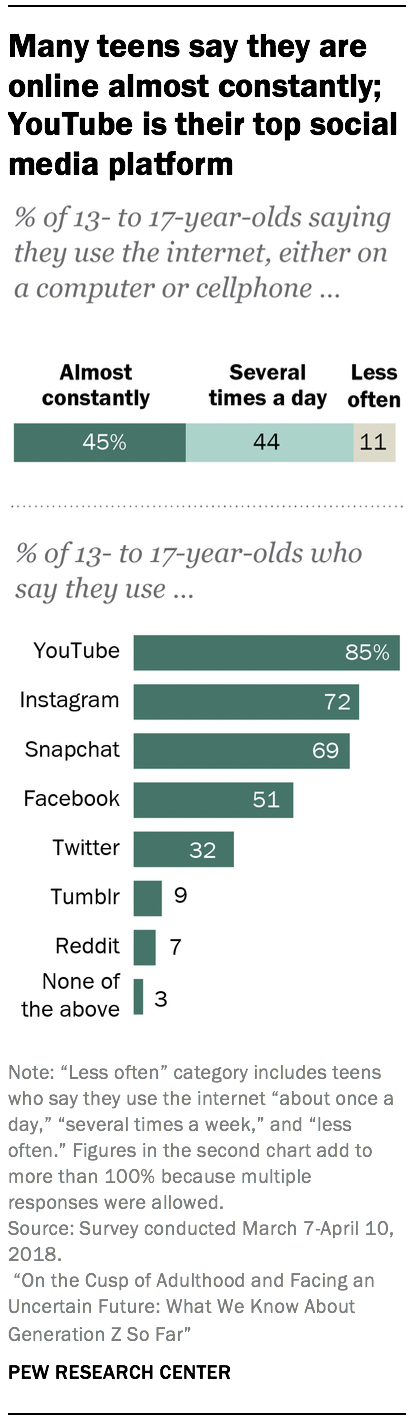
Top 5 social media they use: YouTutbe(85%), Instagram(72%), Snapchat(69%), Facebook(51%), Twitter(32%)
Liberal and open to emerging social trends: They share similar views on many issues with millennials
Likely to highly educated than ever
Short attention span: On average, Gen Z is known to pay attention to content for a span of eight seconds, four less than millennials (VisionCritical).
Media Consumption Habits of Digital Natives
Many teens between 13 to 17 say that they consume online content more heavily than the other generation. 45% of them said they use the internet, either on a computer or cellphone almost constantly, and 44% of them answered several times a day. Only 11% of them said less often.
There are other reports that support this stat. According to Insititute of Business Management, more than 74% of Gen Z said they spend their free time online. Gen Z spends an average of 11 hours on their mobile devices per week(Criteo).
What media channels do they use?
YouTutbe(85%), Instagram(72%), Snapchat(69%), Facebook(51%), Twitter(32%) were the top 5 social media channels the frequently use. (Source: Pew Research Center, March 7-April 10, 2018. On the Cusp of Adulthood and Facing an Uncertain Future: What We Know About Gen Z So Far)
Media Consumption Habits of Digital Natives
Many teens between 13 to 17 say that they consume online content more heavily than the other generation. 45% of them said they use the internet, either on a computer or cellphone almost constantly, and 44% of them answered several times a day. Only 11% of them said less often.
What media channels do they use?
YouTutbe(85%), Instagram(72%), Snapchat(69%), Facebook(51%), Twitter(32%) were the top 5 social media channels the frequently use. (Source: Pew Research Center, March 7-April 10, 2018. On the Cusp of Adulthood and Facing an Uncertain Future: What We Know About Gen Z So Far)
YouTube and Instagram are the most popular channels they visit daily; 62% of Gen Z checks Instagram, while 60% visit YouTube, daily(Business Insider).
What do Gen Zers do with digital devices?
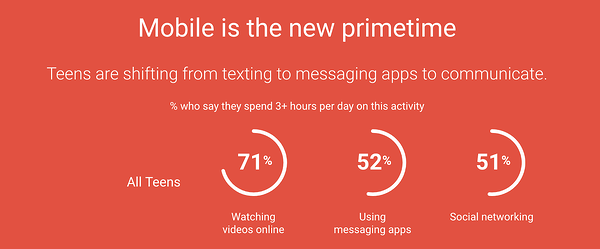
Most Gen Zers use their internet-connected devices to watch videos and to communicate with friends or family. 59% and 58% of them answered they also use them for entertainment and gaming respectively(Institute of Business Management). Roughly 71% of Gen Z teens use mobile devices to watch videos, while 51% use mobile for social media surfing(Think with Google).
Source; Think with Google
Why do they use social media?
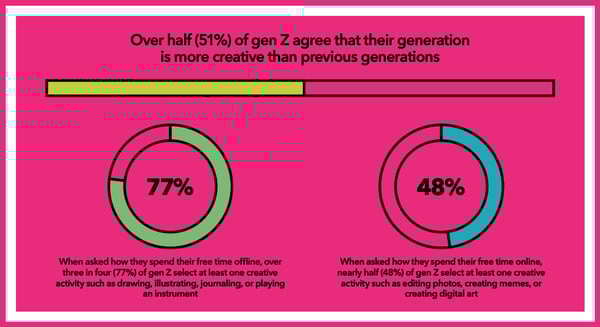
According to Snapchat, 56% of teens answered they use social media apps help them express themselves creatively. 51% of Gen Z agrees that they are more creative than previous generations. 77% of Gen Z reports doing creative activities, such as painting when offline. Meanwhile, 48% say they regularly do creative activities, like meme creation, when online.
This might imply creativity will play a big role in Gen Z’s career drive and values.
How do they think about social media?
While more than half Gen Z agreed that social media helps them be creative, there’s also an opposite idea. According to Pew Research Center, 43% of teens also said that they feel pressure to only post content that makes them “look good” to their friends.
Likewise, many teens had two different ides on social media. Many teens who focus on the positive effect of social media believed that social media helps them stay connected with friends and family. Meanwhile, those who see the effect of social media as negative, the most common reason cited is that it leads to bullying and rumor spreading.
Gen Zers and Millennials have similar viewpoints on many social and political issues
According to Pew Research Center, millennials and Gen Zers are more open and liberal to key issues. When it comes to diversity, they are likely to believe that blacks are treated less fairly in the U.S. and they are more likely to approve the kneeling protest of NFL players during the national anthem.
In addition, according to the same research, half of Gen Zers(48%) and millennials(47%) said that marital diversity(same-sex marriage, interracial marriage etc.) are good for society. The percentage of these people who answered “gay and lesbian couples being allowed to marry is good for society” is comparably higher than Gen X(33%), Boomer(27%), and Silent(18%).
Gen Zers and Millennials have similar views on treatment of people who don’t identify as a man or woman as well. 50% of Gen Zers and 47% of millennials say that the society is not accepting enough of people who don’t identify themselves as men or women. In comparison, the people belong to Gen X, Boomer, Silent generation who answered “not accepting enough” is less than 40% in each generation.
When it comes to social issues, for example, Gen Zers and millennials are the two generations who are most likely to see climate change stems from human activities.
Gen Z and Education
Most-well educated than ever?
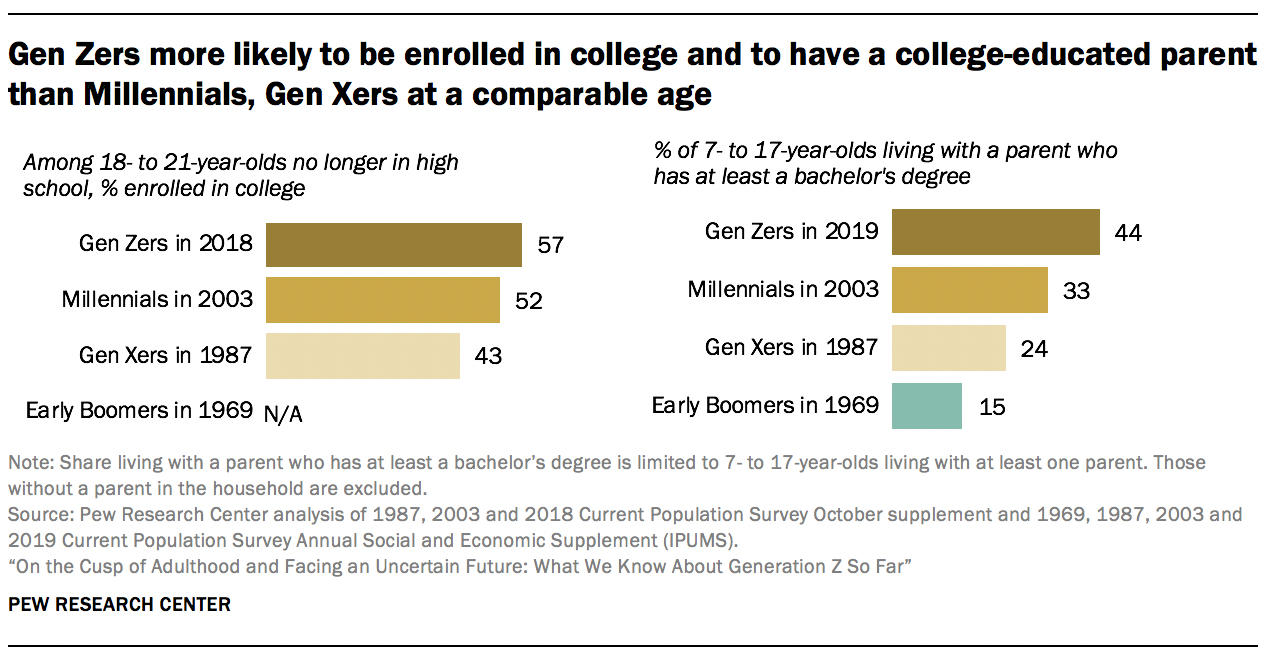
Gen Zers are less likely to drop out of high school and more likely to be enrolled in college. Among 18- to 21-year-olds who no longer in high school, 57% are enrolled in college, which is the highest percentage among Gen X to Z. They(among 7- to 17-years-old) are also more likely to live with a parent who has a bachelor’s degree or higher.
Career-focused generation
Gen Zers are more more career-focused earlier on in their college careers. They believe they are responsible for pursuing their own career. Nearly 42% of Gen Zers also said they want to run their own business, 10% higher than other generations surveyed (Monster).
More career-focused earlier than other generations: nearly a quarter of Gen Z college students start their job search before their junior year (2019 Yello Recruiting Study).
59% of Gen Z will learn new skills if they result in higher pay (LinkedIn).
In short, Gen Zers are tech-savvy, creative, and career-focused.As digital natives, they expect on-demand services that are available at any time and with low barriers to access. Based on this, what they might expect from the classroom is practical learning which is technology-driven, project-based, and adaptable to their workplace or to their goals in pursuit of their career.
You can find more information from Pew Research Center with the link below:
This course gives you an overview of social media marketing, from how to define a target audience to how to create a social media strategy and measure performance.
Linkedin
Length: 52 minutes
Instructor: Brian Honigman, Marketing Consultant, New York University, Adjunct Professor
Curriculum: Social media marketing definition, social media strategy, content publishing, customer interaction, measurement and analysis
This course is a beginner’s guide to Instagram for business. The course teaches you how to create account, how to make a visual story, how to promote posts and use Insights.
Facebook
Length: 10 minutes
Curriculum: Instagram guide for business
This course is provided with text(This is better to be called Guide rather than a training course)
Most popular course among social media guide courses. You can learn how to use their analytics tool, data studio introduction, and fundamentals of Google Tag Manager.
Length: 4-6 hours
Instructor: Justin Cutroni, Krista Seiden, and Ashish Vij
Learn how to quickly set up your YouTube channel and make it work for your business. You can learn their system basics, how to brand your channel, and YouTube guidelines and policies. As you can see in the title “Quickstart”, it’s a very basic course to skim YouTube platform.
Curriculum : Decode YouTube Analytics, Learn about your audience, Understand your video reach, Know how much you earn with YouTube, Get answers to common YouTube Analytics questions, Measure YouTube engagement
This is the summary of HubSpot SEO training course. The course is provided for free and here’s the link for the online course: SEO Free Coures from HubSpot
How Search Engines Rank Your Content
First is the DISCOVERY stage. Search
engine bots discover your web page by “crawling” it – which really just means
it discovers your web page and takes note of all of the content within it.
Next is the RELEVANCE stage. Once a
search engine bot discovers your content, it decides how relevant it is to
certain search queries by indexing it, based on signals like keywords within
the content.
Next is the AUTHORITY stage. This means building enough credibility through backlinks and other factors, that search engines consider your site authoritative enough to rank high in the search results. Authority directly impacts ranking strength.
Discovery Stage
Search engine bots discover your content by crawling it
Relevance Stage
Search engine bots decide how relevant your content is by indexing it (based on signals like keywords) In other words, relevance refers to how well a document matches a search query.
Authority Stage
Search engine bots rank your content in search results based on your site’s SEO authority. Authority directly decides the SEO result More authority = Higher ranking
Steps for SEO compared to choosing books
for shelf-display
Discovery, Relevance and Authority are dependent on one another. If your content isn’t relevant, then it has little chance of ranking, no matter how credible it is. If your website isn’t credible, then it has little chance of ranking, no matter how relevant it is.
Summary: You can build Discovery and Relevance by creating lots of high-quality content on the topics you want to be known for. Authority can be earned by getting lots of high-quality links to your website. Authority directly impacts ranking strength.
Scaling Your Backlink Strategy
How do you accurately measure authority in the first place? Measuring authority comes down to assessing the VOLUMEandQUALITY of the back-links you have to your website. Back-links are a signal to Google that your site is a high-quality resource that people want to reference. That means that sites with MORE back-links – and higher QUALITY back-links – tend to earn higher ranking in search.
What is your “back-link profile”?
Your back-link profile is a list of all the sites currently linking back to your site, which also takes into account HOW they’re linking to your site, and which pages they’re linking to. Your back-link profile shows the number of inbound links to your website, the number of unique domains that link to your website, and the QUALITY of those links – which depends on things like how authoritative the web pages that link to your site are.
One tool that you can use is Moz, which can help you uncover backlinks to your site, find link-building opportunities, and discover links that might be damaging your authority. There are a number of other paid tools that do similar things, like SEMrush, Majestic, and Ahrefs.
Tip 1. Link Building
Link building is the process of manually encouraging people to link to your website from theirs. The key to effective link building is to complement creating great content with manually building links.
How Many Links Does Your Content Need to
Rank on Page One?
You need to make sure you get AROUND the same number of links that the results ranking on page one already have. Knowing how many links THESE highly ranked pages have will give you a baseline target for how many links YOU’LL need.
How to calculate a baseline target for
how many links you’ll need
Choose a broad topic that you want to be known for.
Plug that topic into Google and run a search.
Run the URLs for the top 10 results through a link-checking tool.
Calculate the average number of root domains linking to theses sites.
The Key to Link Building at Scale, Relationship
They all require you to build a RELATIONSHIP with another person or business in order to work. SCALING your link building efforts becomes especially important with those lower-risk, lower-reward tactics. The only way to scale these tactics is by building lasting relationships – with bloggers, journalists, partners, business owners, and influencers.
Give to Getto Build a Relationship
When you’re initiating a relationship, never open by asking them to do something for you. That simply won’t work. The quickest way to start an effective relationship that will lead to more back-links is by delivering some value to them first.
How to Scale Link Building Using Press
Alert Requests
The easiest way to
build relationships with journalists is through responding to press request
alerts. Press request alerts are an absolute gold mine for earning high-value
links and are a way to initiate relationships with journalists that will open
doors to more and more link building opportunities down the road. Press request
alerts are requests that journalists send out asking for sources of
information, like quotes on a certain topic from an industry expert.
Journalists will send
out these requests every day through certain services, and you can sign up for
those services to get the requests in your inbox. If you sign up to get these
requests sent to your inbox, all you have to do is read the requests and look
for topics relevant to your organization, and then respond VERY quickly with
a quote or two that solves the journalist’s need. If you respond quickly
enough and give the journalist exactly the information she wants, then you’ll
likely get a link to your site from a high-quality publication.
In total, you should collect 10-20 different quotes across different varying topics that you can then use, splice, and change, and give back at HIGH SPEED to journalists. Once you’re armed with quotes you can send off at any moment, you’re ready to respond to relevant press requests.
How Does HubSpot Use Blogging to Rank #1 on Google?
Three things that HubSpot tried and made biggest SEO improvements: building topical relevance; optimizing existing blog posts using a process called “historical optimization”; and optimizing featured snippets.
Tip 2. Building Topical Relevance
Figure out which
topics you want to be known for
Publish lots of blog
posts that answer every question about the topics
Link these blogs to
one another
Ex) A blog post series of How to care dogs – (topics =
feeding, bathing, playing, taking a walk etc.)
How HubSpot Builds Topical Relevance
To make our blog posts
more attractive for OTHERS to link to, we added what we call “linkable hooks”
to these posts. “Linkable hooks” are things like original charts and images,
unique data and research, quotes from industry experts, and pros-and-cons
tables, which we find people like to link to.
The key to success
with this approach is the move past short-term thinking and put a lot of work
into building a thoughtful strategy, building key relationships that will help
you build links, and create great content with linkable hooks.
Tip 3. Optimizing Featured Snippets
“A featured snippet is
a summary of an answer to a user’s query, which is displayed on top of Google
search results. It’s extracted from a webpage and includes the page’s title and
URL.”
How to optimize for the featured snippet
Identify your blog posts that currently rank in position #1 – #5 and estimate which keywords they’re ranking for
See if a featured snippet appears in search for those keywords
Optimize your posts for the featured snippet. Format it cleanly.
Submit the URLs to be re-crawled.
Tip 4. Historical Optimization
Historical optimization means optimizing your old blog posts so that they’re fresh, up-to-date, and can rank higher in search results – thereby generating more organic traffic than they already do.
Google rewards freshness. Google introduced a freshness factor into its ranking algorithm in 2011. Google wants to surface high-quality, valuable content that’s fresh and up-to-date for searchers. Two, you’re building off the existing search authority that the post has already accumulated. In other words, you’re starting with a post that already has some degree of page authority instead of starting completely from scratch. Three, the surge of new visits you get from re-promoting your updated post to your blog subscribers and social media followers will naturally lead to new inbound links and social shares, which are both important ranking factors.
[A1]Crawling means that Googlebot looks at all the
content/code on the page and analyzes it. Indexing means that
the page is eligible to show up in Google’s search results.
A crawler is a program that visits Web sites and reads their pages and other information in order to create entries for a search engine index. The major search engines on the Web all have such a program, which is also known as a “spider” or a “bot.”
Micro-Moments are defined as moments during the day when a consumer instinctively reaches for their smartphone to find, go, do, or buy something. In short, it’s a rich-intent moment that a consumer turns to their device as they need something. In these moments, the possibilities that a brand can win over specific actions from customers are high.
Brands can create an intimate connection, reaching consumers ate the precise instant when they are ready to know, shop, go, or to buy. Marketers like to call this narrow window, when a consumer is motivated to make a decision, a micro-moment.
Examples of Micro-moment in marketing
Baemin, how they use micro moments to get more reviews
Baemin, a Korean food delivery app, pushes a message that tasks a review when a person who ordered food almost or already finished eating. This is the way the app collects a number of reviews.
A design for Micro-moment, Uber
Uber’s integration in Google maps is a perfect example of how you get information when it’s most needed: “I’m going to Google maps to find a place and it’s very likely I will need transport to get there”, hence Uber’s plugin into Google Maps:
Google’s Lyft and Uber integration in Google maps.
Hyundai brought test-drives to your door
Hyundai discovered that consumers struggled to find time to test-drive a car, but test-drives significantly increase the likelihood of purchase. So Hyundai tried an online program that brought test-drives to consumers, either at their home, office, or local hangout spot. It was a huge success, with 90% of customers saying it was the deciding factor that got them to a dealership. (How Hyundai changed course to improve the customer journey. ThinkwithGoogle)
Leveraging micro-moments marketing, there could be yet-to-be-discovered opportunities. And more possibilities to win over users’ or customers’ actions, too! Tap into micro moments for your marketing strategies and make sure your brand be there in these moments of need.
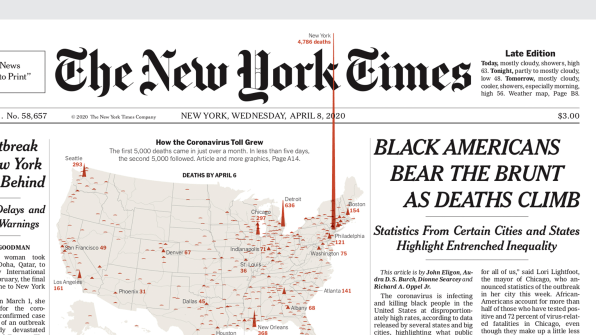
During the pandemic, the New York Times tried several unconventional attempts to illustrate severe and astonishing aspects of its influence. On its front page, the list of names took over the front page. Or they emptied the nearly one-third of a page to illustrate social distancing.
The New York Times and Social Distancing
Delivering a powerful message with a simple design
The New York Times
The New York Times illustrated social distancing through its eye-catching design. The Times allocated a significant portion to illustrate self-isolation. The design is simple but intuitive, making the message powerful.
The paper presented a numerous loss of lives from the pandemic in a solemn way
Dedicating a whole page to the names
In the same month, The Times demonstrated the damage of pandemic in a distinctive way using its front page.
Normally, articles headlines, photographs, information graphics appear on the first page. Especially, photographs and visual graphics come on the front page on Sunday. Instead of these elements, a list of people who lost lives due to the Covid-19 took over the whole front page.
New York Times presented a number of names and memories from obituaries across the country
This was when the death toll from coronavirus in the United States approaches 100,000, and the paper demonstrated this national loss in a solemn way. They gathered names of the dead and memories of their lives from obituaries and death notices from various sources. According to the New York Times, Alain Delaquérière, a researcher, compiled a list of names. Then a team of editors and three graduate student journalists compiled personal data that depict their lives from newspapers and online sources.
In March, 2020, unemployment claims almost reached 3.3 million due to a widespread economic shutdown brought by the Covid-19. That’s about 5 times more than the number of previous highest unemployment claims, which was 665,000 in March 2009, during the recession.
To visualize this soar, the Times gave its right column to a graphic that goes all the way up to the right side of the page. This soaring graph marks how the economic toll was stark at the moment.
The New York Times
Death toll spiked through the logo
Three thousand more people died in New York City between March 11 and April 13. (The New York Times) When the death toll spiked in New York city, the New York Times mapped the coronavirus toll across the country with spike visual elements. In the map, New York City’s fatailities spiked through the logo, making the focus clearer.
The New York Times
The unconventional graphic presentation, the key to make your content stand out
The well-made design brings into clearer focus the facts and key messages. As seen above, no matter how simple that is, a well-designed graphic tells you the stories behind the text, inspire your thoughts, and deliver the unseen messages.
This is why design has become key for many media content. Even the New York Times utilized their the most precious real estate, the front page, in an unconventional way to grasp reader’s attention and convey meaning effectively.
Marketing learning courses that will validate your ability
Marketing certification is not always required to work, but if you want one, there are many ways to achieve them. You can take a marketing or communication online courses from universities, companies, or marketing platforms. The problem is, there are many options out there and it is hard to figure out what to choose at first sight.
So, I classified digital marketing courses into several groups: Content Marketing, Social Media Marketing, SEO Marketing, Online Advertising, Marketing Analytics, and Others.
Photo by Stephen Phillips – Hostreviews.co.uk
Certification for specific digital marketing skills
If you want to advance your career and pursue a graduate degree, there are some certifications from accredited universities. Many of them have online master’s degree program in marketing or communication. Many programs are flexible enough that you can work and study simultaneously.
I, myself, also earned my graduate degree in communication from one of these universities. Some of the universities several years of work experience and that means, if admitted, you can learn with other specialists from different industries(which was helpful for me to broaden my insight).










 Ideas for Social Impact